| Uncle Al's 2017-2020
Racing Rules in Pics Rules are quoted, then illustrated and explained as seems necessary. Part 2C - At Marks and Obstructions for instant access without scrolling, click on the Rules listed below 18 Mark-Room 18.1 When Rule 18 Applies 18.2 Giving Mark-Room 18.3 Tacking when approaching a Mark 18.4 Gybing 18.5 Exoneration 19 Room to Pass an Obstruction 20 Room to Tack at an Obstruction |
|
|
 |
|
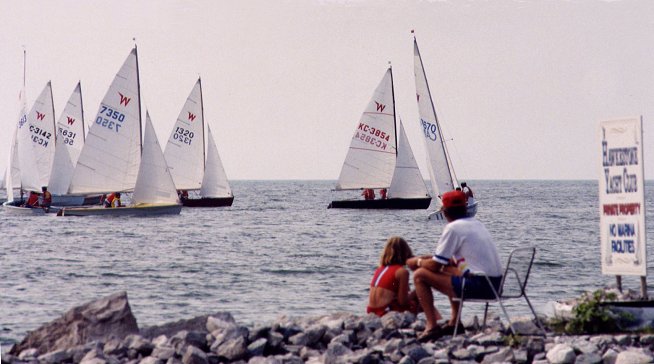
I had to dig deep (1998
Wind Bag Regatta) to find a time when we had what the
above preamble refers to indirectly: a starting mark not
"surrounded by navigable water". Here, the RC are
sitting on the mark at the starboard end of the line -
the shore!! This is the only kind of starting mark at
which rule 18 does apply. At 99.9% of start
marks, rule 18 does not apply, hence the
greeting: "You're barging!!" when someone tries to
squeeze in at the windward end. Allowing buoy room at a
start would create chaos!!!
Note though, that last
little bit of 18.1(a) which explains that "buoy room" is
only suspended when boats are approaching the line to
actually start, i.e. you can call for "room" at
a start mark with a couple of minutes to go in the
countdown (unless you sail in a class where it's common
practice to "sit" in your spot on a 100-boat line that
early).
... |
| DEFINITION: MARK-ROOM Mark-Room Room for a boat to leave a mark on the required side. Also, (a) room to sail to the mark when her proper course is to sail close to it, and (b) room to round the mark as necessary to sail the course. However, mark-room for a boat does not include room to tack unless she is overlapped inside and to windward of the boat required to give mark-room and she would be fetching the mark after her tack. |
 |
|
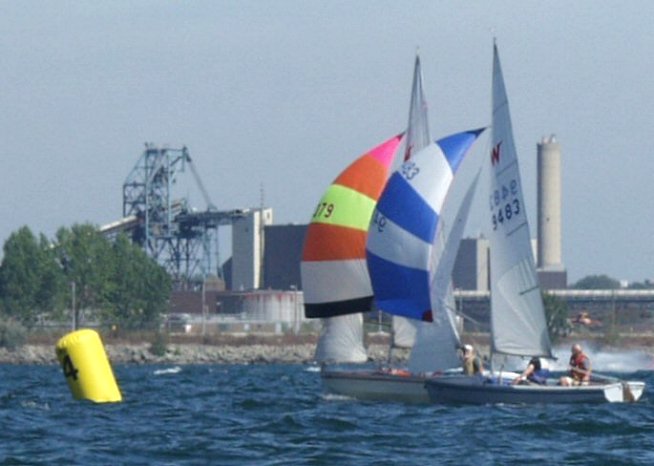
Imagine that Geoff
Edwards (W9483) and Fred Black (W7379) are about to
round mark #4 to starboard. Fred is the inside boat
(i.e. he is overlapped on the inside). Assuming he is
entitled to mark-room, such room will include only
enough room to sail to the mark. As give-way boat
(windward), Fred is not entitled to sail his proper
course which might well be to approach the mark wide and
leave it close (a so-called tactical rounding). Once at
the mark, Fred will be entitled to sail proper course as
he rounds, and if he is still overlapped with Geoff,
mark-room will give him the right to tack at this mark.
But as soon as Fred is no longer "at the mark", his
mark-room protection from the leeward right-of-way boat
ends, and he must as of that moment again keep clear.
... |
 |
|
Below, our former kitten
(above) - who loved the keyboard - puts in his
"two paws' worth" and tells us what he thinks of rule
18:
"fffffffffffffffffrrrrrrrrrrrrrrrffffffffffffffffffffffffffffffffffffffffffffffffffffffffff."
He
now lives out in the country where he can chase real mice!!
... |
 |
|
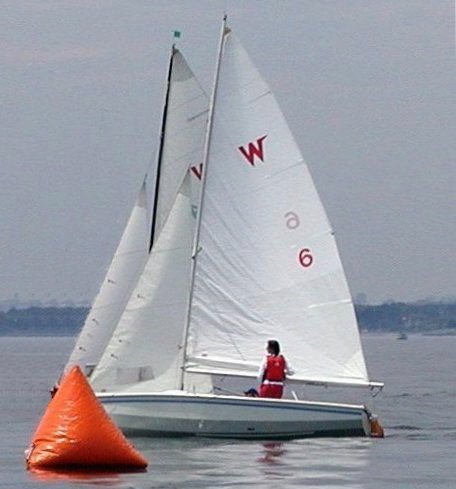
This photo again shows
how mark-room
entitles a boat to tack as part of the rounding
manoeuvre. Note that Tanya Wharton (W6) is inside boat
and the mark-room
that Uncle Al (just to leeward of Tanya) gives her will
have to include room to tack (i.e. to swing her stern
wide - so to speak - as she tacks). Ironically, if
Tanya were clear
ahead here, she would not be immune to the
requirements of rule 13 (Tacking). See
also rule 18.2(c).
... |
 |
|
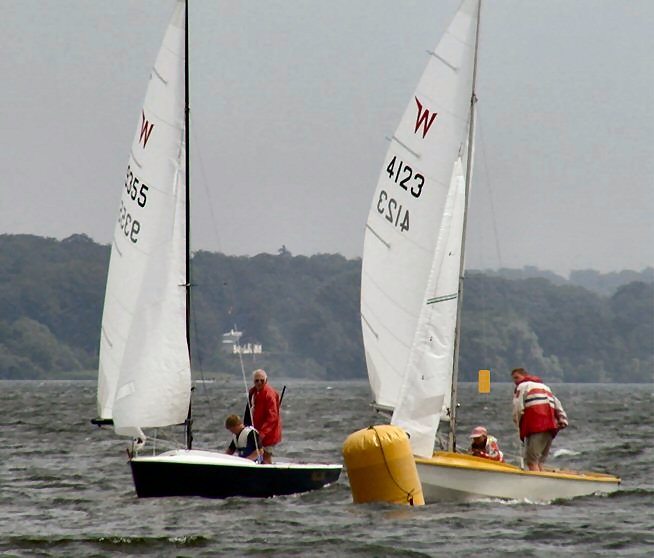
A reach-to-reach tack
around a mark (fortunately) happens once per year at
best - and it didn't happen above, either. But it was
the closest picture I had, so I added a mark (just above
the lovely Lise Jonasen in W4123) to which Søren Jonasen
(W4123) and Uncle Al with super-crew, Anders Pjetursson,
in Whistle (W9355) will have to sail next. Of
course this will require a tack followed by a close
reach on starboard tack. The mark-room definition (above) indicates that Søren, the
inside boat, is entitled to room to tack here. But again
- if Søren were clear ahead, he would ironically not
be entitled to tack as part of his mark-room.
... |
| Zone The area around a mark
within a distance of three hull lengths of the boat
nearer to it. A boat is in the zone when any
part of her hull is in the zone. |
| 18.1 When Rule 18 Applies Rule 18 applies between boats when they are required to leave a mark on the same side and at least one of them is in the zone. However, it does not apply (a) between boats on opposite tacks on a beat to windward, (b) between boats on opposite tacks when the proper course at the mark for one but not both of them is to tack, (c) between a boat approaching a mark and one leaving it, or (d) if the mark is a continuing obstruction, in which case rule 19 applies. |
 |
|
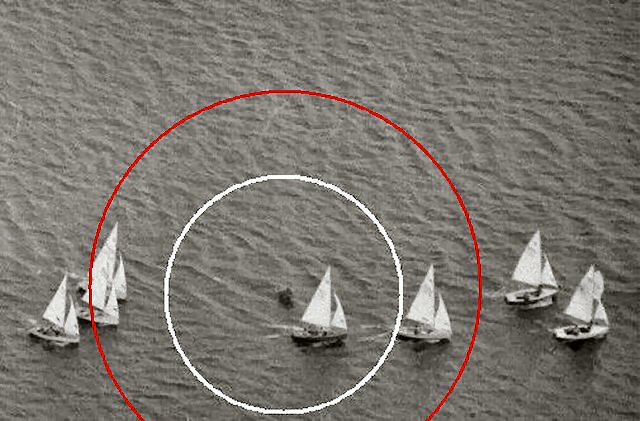
The above shot from the
1986 Wayfarer Worlds on Lake Couchiching is the only
aerial photo I have on which I can demonstrate the
re-defined zone which was enlarged in 2013
from the old "two-length zone" (white circle above) to three lengths
(red circle) as
follows:
Zone The area around a mark within a distance of three hull lengths of the boat nearer to it. A boat is in the zone when any part of her hull is in the zone. Rule 18 no longer begins
to apply when boats are "about to" pass or round a mark
which could have been outside of the zone and which
tended to be a judgment call. Nowadays, the point at
which rule 18 begins to apply is made quite clear: rule
18 turns on at the moment when "at least one of [the boats] is in the zone".
And
note that for a boat to be in the zone,
part of hull must be in it - not her bowsprit, sails,
etc. The three boats on the left in the photo above were
thus subject to rule 18 the moment part of the hull of
one of them entered the zone.
... |
 |
|
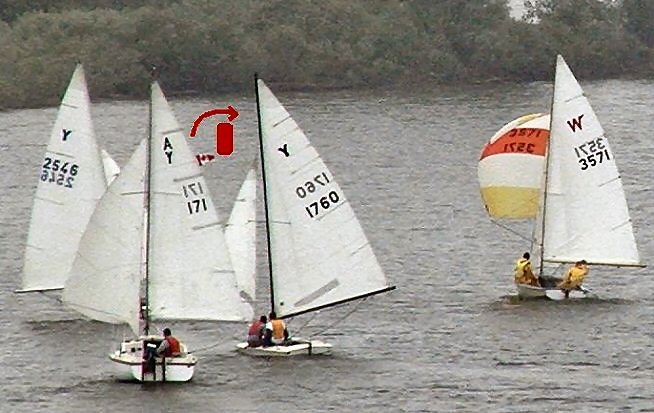
In the photo above,
Y-Flyer 2546 and W3571 (Bob Kennedy) may well converge
as they near the mark which I have inserted and which
they had to leave to starboard. Until one boat enters
the zone and
turns on rule 18, the starboard Y-Flyer (2546) is
permitted to call his rights on the three port-tack
boats. If W3571 has an overlap on Y2546 when rule 18
turns on, 3571 will be entitled to mark-room but
as give-way boat, he will be entitled only to mark-room
and no more, i.e. room to make a seamanlike (not tactical!!)
approach to the mark followed by a proper-course
rounding once he is at the mark.
... |
 |
|
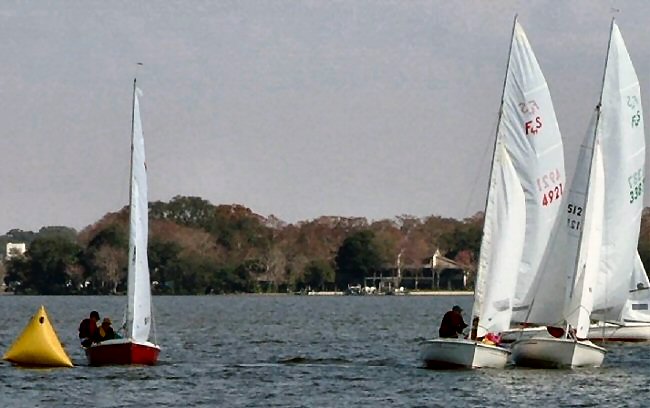
And even if rule 18
definitely applies, don’t forget that if a windward boat
rounds with an inside overlap on leeward, the latter -
as leeward boat - remains the right-of-way boat. Above,
Flying Scot 4921 is entitled only to mark-room
(the space needed to make a safe, seamanlike rounding),
and not the space needed for a tactical rounding (wide
and close). Above, FS4921 has taken far too much room
and is fouling FS3387 to leeward of him.
... |
| "required to leave" "on the same side"
refers to the possibility that boats from different race
courses may meet at a mark which they pass on the same
side but in opposite directions - one buoys to port, the
other buoys to starboard. Then rule 18 does not apply and
it's back to basics, e.g. rule 10 and 11. ... |
 |
|
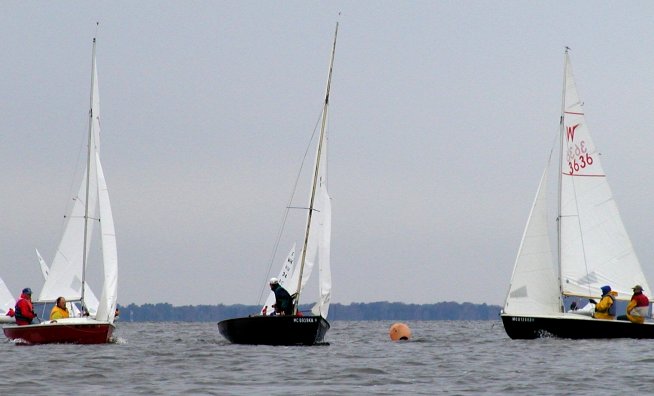
This picture illustrates
rule 18.1(a): namely that rule 18
does not apply between boats on opposite tacks on a beat
to windward. Here, Hubert Dauch (W3636) - as the
port-tack boat - is bound to keep clear of both Nick (blue
hull) and Gale (red hull).
... |
 |
|
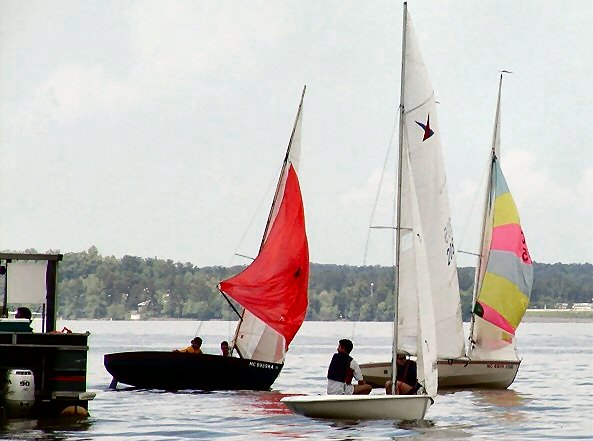
Quick, now! Is Judd
Lather (red spinnaker) protected by rule 18 at a
finish mark??? - Yes, he is. Bob Frick (the Wayfarer
to leeward of Judd) has to give him mark-room.
The only mark
at which rule 18 (almost) never applies, is at a start
mark. Of course, if the last leg is a beat, then rule 18
still won't apply between boats on opposite tacks at a
finish mark.
.... |
| 18.2 Giving Mark-Room (a) When boats are overlapped the outside boat shall give the inside boat mark-room, unless rule 18.2(b) applies. (b) If boats are overlapped when the first of them reaches the zone, the outside boat at that moment shall thereafter give the inside boat mark-room. If a boat is clear ahead when she reaches the zone, the boat clear astern at that moment shall thereafter give her mark-room. (c) When a boat is required to give mark-room by rule 18.2(b), (1) she shall continue to do so even if later an overlap is broken or a new overlap begins; (2) if she becomes overlapped inside the boat entitled to mark-room, she shall also give that boat room to sail her proper course while they remain overlapped. (d) Rules 18.2(b) and (c) cease to apply when the boat entitled to mark-room has been given that mark-room, or if she passes head to wind or leaves the zone. (e) If there is reasonable doubt that a boat obtained or broke an overlap in time, it shall be presumed that she did not. (f) If a boat obtained an inside overlap from clear astern and, from the time the overlap began, the outside boat has been unable to give mark-room, she is not required to give it. |
 |
|
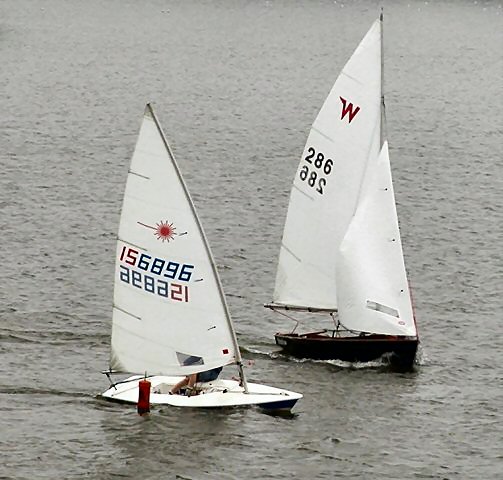
Here, Peter (W286) is
the outside boat and has to give room to the inside boat
(the Laser). Not only that, the inside boat has right of
way (leeward) so that Peter must "also keep clear"
- in so many words, the right-of-way inside boat can
take as much room as he likes! Once past the mark, the
leeward boat can sail any course he likes, also
(assuming that rule 18.4 does not
come into play!).
..... |
 |
|
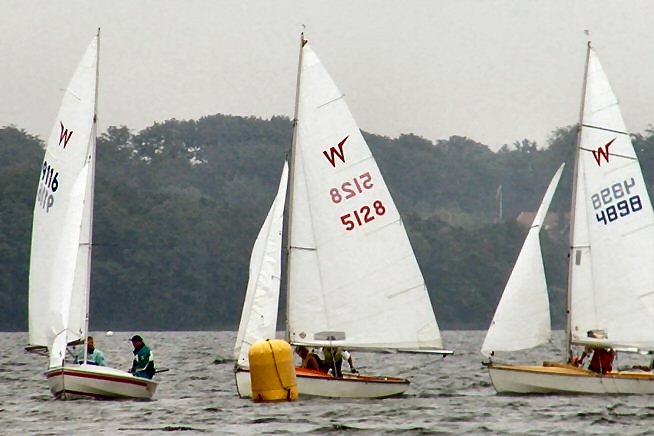
In essence, 18.2(b) freezes
the action and the rights as the first of a group of
overlapped boats reaches the zone. If at that
precise moment you had rights to mark-room
(i.e. you were overlapped
inside the other boat), you keep those rights through
the rounding even if you then lose the overlap
inside the zone.
If the other boat pulls ahead, he must still give
you mark-room.
The photo above illustrates another common possibility:
Christian Bovet (W5128) was overlapped inside Paul
Knowlson (W9116) at the moment one or the other of them
first reached the zone.
Here, Christian may well go wide of the mark as he
gybes, tempting Paul (or Stephan 4898) to try to cut
inside of Christian. An admirable move - if it works.
But 18.2(b) underscores the fact that a boat trying to
cut in has few rights in such a situation: if Christian
starts wide here, but then cuts the mark close with a
non-mark-room boat wedged in there, the latter is out of
luck! Penalty turns time!!
Silver lining: Whereas at one time, for decades, the mark-room-entitled boat could do anything short of tacking to squeeze out a boat trying to sneak in, the mark-room definition (2013) now limits the mark-room boat to sailing no higher than her proper course. It is important to note also, that from the moment Christian gybes, his rights to a tactical rounding expire because he is now the give-way boat to both W9116 (leeward) and W4898 (starboard). From this point on, he is thus only entitled to mark-room (seamanlike course to the mark plus a proper-course rounding once he is at the mark) with regards to W4898 and W9116 even though he reached the zone clear ahead of Stephan Nandrup-Bus (W4898). Moreover, if you leave
the zone again before rounding, e.g. by going
too wide, etc., you have pushed the nautical equivalent
of the reset button [18.2(d)}: your
situation must be re-evaluated because any rights you
may have had, have - alas - not been saved!!
.. |
 |
|
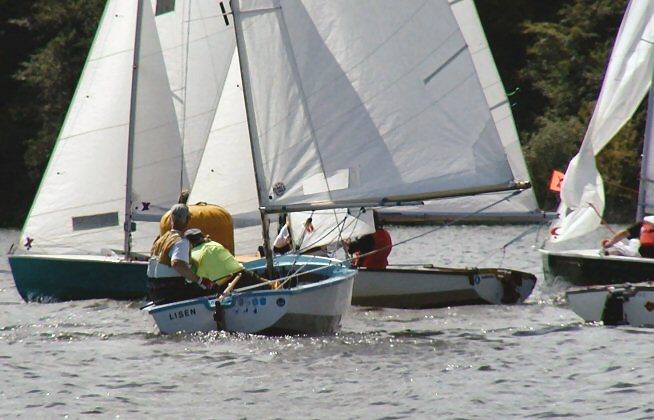
18.2(b)
is another case of freezing the action - in this case
with one boat clear ahead of another as she reaches the
zone. Here, John Friis (with Mary in the lime
green PFD!) was clear astern of all the other boats seen
in the photo when they reached the zone.
According to 18.2(b) and regardless of the mess that may
soon develop at the mark
(off John's port bow), John must
|
 |
|
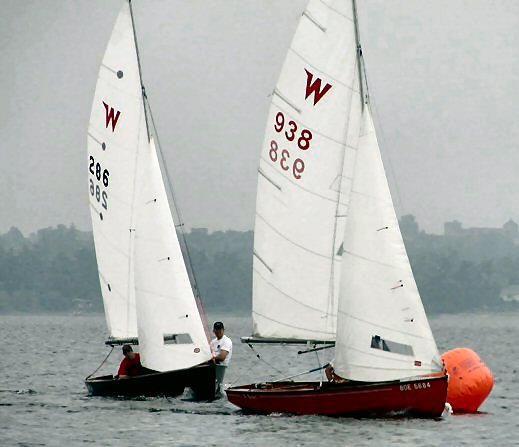
Note however that
the boat which is clear ahead (e.g. Hans Gottschling,
W938, in the photo above) is not entitled to tack as
part of its rounding procedure - see the last sentence
of 18.2(d): "Rules 18.2(b) and (c)
cease to apply when the boat entitled to mark-room
... passes head to wind or leaves the zone." - which
means that rule 13
does apply (see Case
81) and if Hans tacks here, he may well foul
Peter Rahn (W286). The mark-room
definition further underscores this as follows: "mark-room does not include room to tack unless the
boat is overlapped
to windward and on the
inside of the boat required to give mark-room."
... |
 |
|
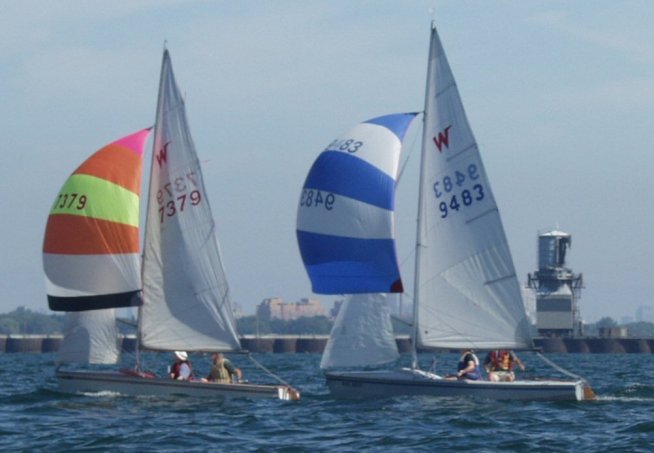
Rule 18.2(e) points
out that it is up to a boat that claims there was a
last-second change in status - overlap gained or
broken - to prove that fact. In the picture above, Geoff
Edwards (W9483) ended up getting an overlap inside W7379
(Fred Black) near the gybe mark. If the question of
"buoy room" came to a protest, Geoff would need to
convince the committee that he had indeed established
the overlap in time. If there was reasonable doubt, see 18.2(e) above.
Also included in 18.2 -
in part (f) - is the fact that you are not entitled to mark-room
if the outside boat is unable to give room from the
moment you establish your inside overlap - even before
reaching the zone. I still recall a race from
the heydays of the June Bug Regatta at Fanshawe in the
mid-80's: The wind died right near mark 4 (about 50
metres from the shore) as we ghosted towards it on a
late Saturday afternoon run. By the time we got near the
mark, there were already 50+ boats of all shapes and
sizes wedged in between the mark and the shore - and
also on the wrong side of the mark. This was presumably
an example of where we could have gotten an inside
overlap well before the zone but where the outside boat
had no hope of actually giving us the mark-room and so
we weren't entitled.
... |
| 18.3 Tacking
in the Zone If a boat in the zone of a mark to be left to port passes head to wind from port to starboard tack and is then fetching the mark, she shall not cause a boat that has been on starboard tack since entering the zone to sail above close-hauled to avoid contact and she shall give mark-room if that boat becomes overlapped inside her. When this rule applies between boats, rule 18.2 does not apply between them. |
 |
|
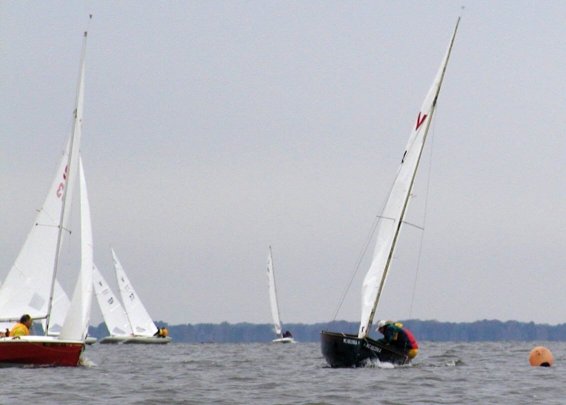
Here Nick is about to
complete a tack inside the zone in front of Gale
(left) who is laying the mark which is to be
left to port. (Note that 18.3 no
longer applies at buoys-to-starboard roundings!)
Thus, rule 18.3 applies. This means Nick will not have
the protections of rule 18.2 such as being entitled to
room and freedom from the restrictions of rule 16 (the right to
change course as he sees fit to round the mark). In
addition, W864 (Nick) shall (a)
not cause [Gale] to sail above close-hauled to avoid
[Nick], and shall (b) give
room
if the other (red) boat becomes overlapped
inside her.
Basically, (a) the above leaves Nick at the mercy of Gale who can (successfully) protest Nick if Gale feels he had to sail above close-hauled because of Nick's boat being in the way, and (b) the above means that Gale can shove his nose in to leeward of Nick unhampered by the restrictions of rule 15 such that Nick probably has no hope in hell of keeping clear. As you can probably tell, our rules makers are trying to discourage us from tacking in traffic near a windward mark to be left to port. And they have done a good job!! I myself make it a strategic priority to try to avoid tacking in(to) the zone unless there are no other boats near me. |
 |
|
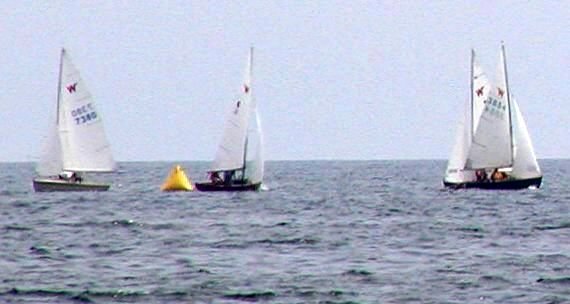
This situation actually
ended up with a protest. While Paul Laderoute (W7380)
rounded relaxed and in the lead, second place was a
close battle among Heider Funck (W6), Uncle Al (W3854)
and Peter Rahn (upwind of Al). Worried about completing
his tack inside the zone and too close to Peter,
Uncle Al is bearing away behind Peter instead of going
for a lee-bow. Al then tacked as soon as he could do so
without hitting Peter. Heider held on until he had to
bear away behind Peter as well - about one boatlength
from the mark. W6 then tacked into the half a boatlength
or so between Peter and Al. This tack likely broke rule
13 (tacking too close) but
Heider definitely infringed 18.3 because Al had to luff
up beyond close-hauled and still collided with
W6. Penalty turns were duly done by Heider.
... |
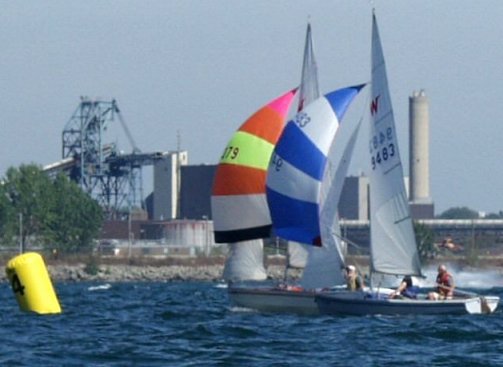
| 18.4 Gybing When an inside overlapped right-of-way boat must gybe at a mark to sail her proper course, until she gybes she shall sail no farther from the mark than needed to sail that course. Rule 18.4 does not apply at a gate mark. |
 |
|
Here, Geoff Edwards
(W9483) is "an inside overlapped right-of-way boat".
Since the next leg is a port-tack reach, he "must gybe"
to sail his proper course. Because that is the case,
Geoff must make a proper course rounding, i.e.
he is permitted to do a wide-and-close rounding
but is not allowed to deliberately take Fred
Black (W7379) far past the mark instead of sailing his proper
course. In so many words, Geoff must gybe where he
would gybe if no other boat was near by.
It should be noted
however, that if the next leg were a very broad reach or
a run, then 18.4 would not apply since it addresses only
boats who "must" gybe to sail their proper course.
... |
|
This photo illustrates a
situation where rule 18.5 might
come into play. Under normal circumstances, rule 16.1 might well
prevent Uncle Al (leeward boat in W3854) from
changing course towards Hans Gottschling (windward
in W938) because the two boats are so close
together that a course change by Al may not leave Hans
enough room to keep clear. But here rule 18 applies so
that, as per 18.5, rule 16 does not apply to Al who is
free to alter course as he feels is necessary to round
the mark. Hans must be prepared for this and make sure
he is able to keep clear despite any (reasonable!)
course change (such as luffing above close-hauled to
"shoot the mark") that Al may feel is required.
..
|
| 19 Room to Pass
an Obstruction 19.1 When Rule 19 Applies Rule 19 applies between two boats at an obstruction except (a) when the obstruction is a mark the boats are required to leave on the same side, or (b) when rule 18 applies between the boats and the obstruction is another boat overlapped with each of them. However, at a continuing obstruction, rule 19 always applies and rule 18 does not. 19.2 Giving Room at an Obstruction (a) A right-of-way boat may choose to pass an obstruction on either side. (b) When boats are overlapped, the outside boat shall give the inside boat room between her and the obstruction, unless she has been unable to do so from the time the overlap began. (c) While boats are passing a continuing obstruction, if a boat that was clear astern and required to keep clear becomes overlapped between the other boat and the obstruction and, at the moment the overlap begins, there is not room for her to pass between them, she is not entitled to room under rule 19.2(b). While the boats remain overlapped, she shall keep clear and rules 10 and 11 do not apply. |
 |
|
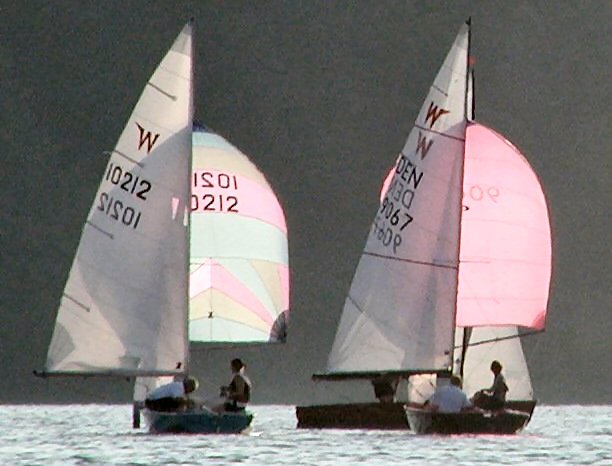
Above, Søren Jensen
(W10212) and Sten Madsen (W9067) are overlapped on a
starboard-tack run. Both have to keep clear of
the close-hauled starboard boat off Sten's bow which
as leeward boat has right of way over both Søren and
Sten, and will rank as an obstruction to Sten. Although Søren
has right of way over Sten under rule 11, rule 19
requires that Søren give Sten enough room - as opposed
to mark-room - to
pass the obstruction,
i.e. the right-of-way boat (Søren, leeward) must move
out of the way
(only) to the
extent that the give-way boat (Sten, windward) is able
to pass the obstruction
without fear of collision. As soon as the obstruction that
caused rule 19 to "kick in" has been passed,
everything reverts back to the rules of the other
sections of Part 2.
...If Søren had so desired and had acted early enough, he could have chosen to sail high and pass in front of the leeward (beating) boat, as provided under rule 19.2(a). |
 |
|
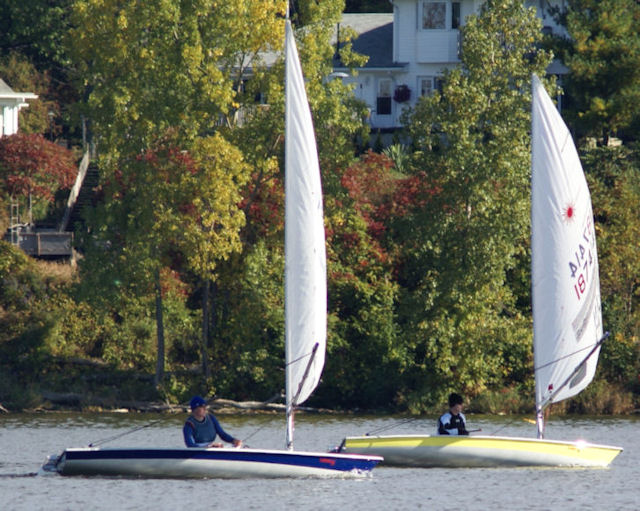
The obvious continuing obstruction that
springs to my
mind is a shore
along which the boats are sailing - such as the east
side of Fanshawe Lake above. Let's pretend that here
Kevin Biskaborn (yellow Laser) came up from clear
astern in trying to pass his brother, Brad (blue Laser). Under rule
19.2(c), Kevin was entitled to room only if at
the moment he established his overlap between
Brad and the continuing obstruction (the shore) there was room for him to
pass between them.
... |
 |
|
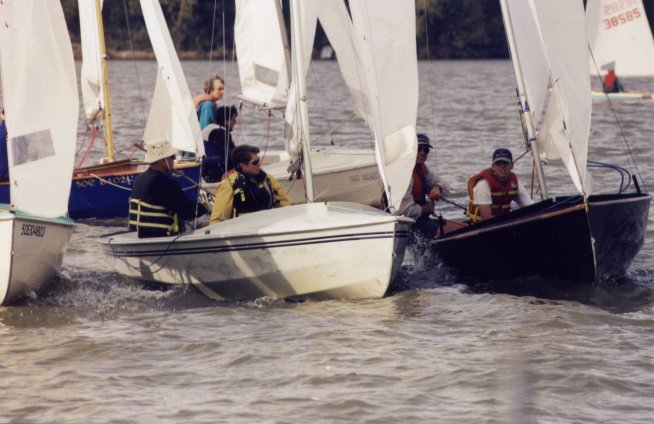
R.I.P. A
right-of-way boat sailing along beside you used to rank
as a continuing obstruction, so that line-sitters like
the Wayfarers above were protected from interlopers
coming from astern under what is now rule 19.2(c). But
the revised obstruction
definition now rules that out: "A vessel under way, including a boat racing,
is never a continuing obstruction". This
may well affect our start line strategies since a boat
coming up from astern can now shove his nose in to
leeward of your transom even if there is not room for
his boat to fit between you and a boat to leeward of
you. The way new rules read, the windward boat must take
evasive action the moment leeward establishes an overlap. At that
point, the only feasible evasive action may well be for
you to speed up and cross the line early. Stay tuned!!
... |
|
20
Room to Tack at an Obstruction
|
 |
|
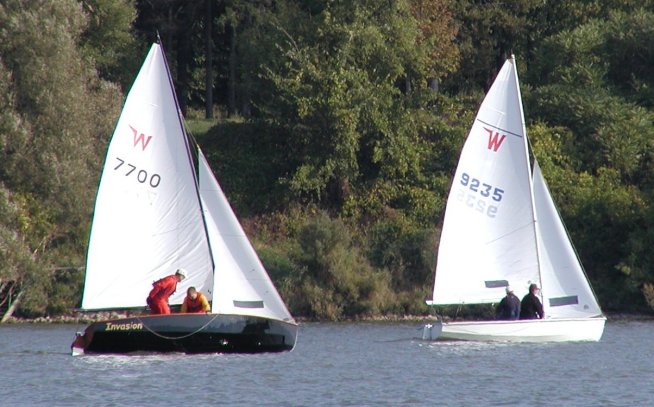
Here, Roger (W7700) is
just completing a tack to starboard and will now be
sailing along just to windward and astern of Brian
(W9235). If Brian is worried about hitting an obstruction (the
shore), but is likely to foul Roger by tacking, rule 20.1 lets Brian ask Roger for "room to
tack".
Brian must do this on the early side because
In the photo above, the following sequence of events might typically occur:
Note that rule 20
applies only where the boat asking for "room to tack"
cannot tack and then keep clear of the other boat, i.e.
if Brian (9235 above) can tack and then bear away to
keep clear of the starboard boat (7700), Brian
must do so without invoking rule 20.
... |
 |
|
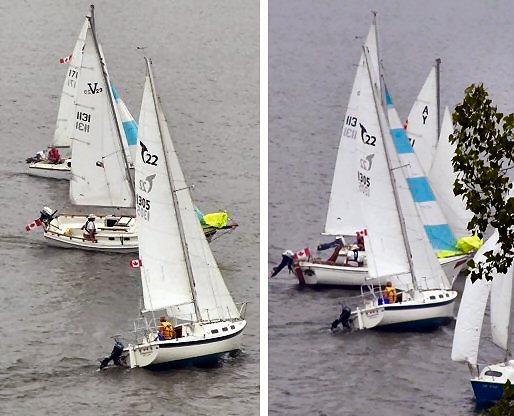
In the photo above on
the left, 1305 (starboard) is an obstruction to 1131 who
is on port tack. Therefore 1131 would have had the right
to hail 171 for "room to tack", had he done so well
before the moment captured here. Having not hailed, 1131
is now blissfully sailing into a situation where he is
sure to foul the starboard boat (1305) since he's left
it too late to bear away, or he will foul the boat to
windward of him (171) by doing a crash tack (see
photo on right) to avoid 1305.
...There are usually two possibilities for the leeward boat who can hail for room to tack, or pass astern of Starboard. If Leeward opts to call for "room to tack", then Windward cannot claim room to pass astern of Starboard, since rule 19.2(a) gives the right-of-way boat the choice as to which side to pass the obstruction on. Note however, that unless Leeward has to make a substantial course change in order to avoid the r-o-w boat, the latter will not qualify as an obstruction. If, on the other hand, Leeward chooses to pass behind Starboard, rule 20 is not being applied. Therefore Leeward must - under rule 19 - allow Windward (AY171 in this case) room to pass astern of Starboard, also. |
 |
|
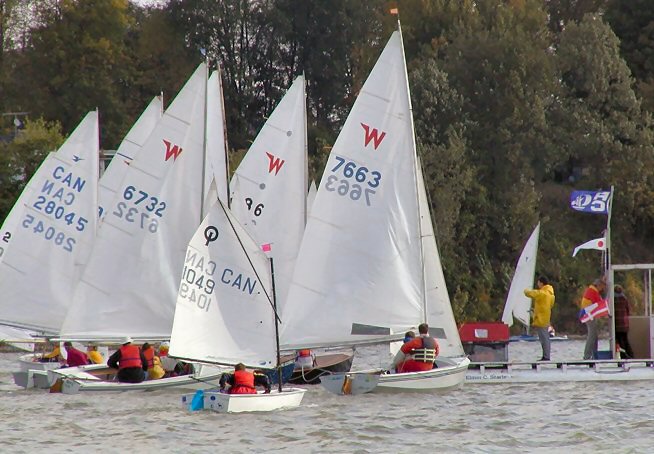
This picture tells the
story of why rule 20 cannot be allowed to apply at a
starting mark, even if that mark (the RC boat in this
case) is large enough to qualify as an obstruction.
Imagine the absolute mess that would be created if Peter
Rahn (286) for instance, got wedged in towards the RC
boat and could now request room to tack!!! Which is why
the Section C preamble states: "Section C rules do not apply at a
starting mark surrounded by navigable water or at its
anchor line from the time boats are approaching them
to start until they have passed them."
.. |
|
Rules
in
Pictures index
DefinitionsPart 2A Part 2B Part 2C Part 2D + penalty turns Photo-based Rules Quiz - 1 Photo-based Rules Quiz - 2 |