| Uncle Al's 2017-2020
Racing Rules in Pics Rules are quoted, then illustrated and explained as seems necessary. Section 2B - General Limitations for instant access without scrolling, click on the Rules listed below 14 Avoiding Contact 15 Acquiring Right of Way 16 Changing Course: 16.1 16 Changing Course: 16.2 17 On the Same Tack; Proper Course ... |
| 14 Avoiding Contact
A boat shall avoid contact with another boat if reasonably possible. However, a right-of-way boat or one entitled to room or mark-room (a) need not act to avoid contact until it is clear that the other boat is not keeping clear or giving room or mark-room, and (b) shall not be penalized unless there is contact that causes damage or injury. |
 |
|
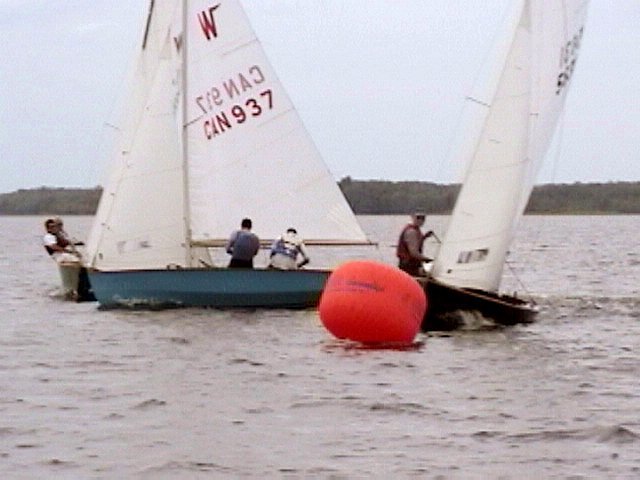
At about this point, it
became clear to Uncle Al (far left) that
Wayfarer Man (Frank Goulay) who was sailing W937
(a.k.a. W828) and who had just ducked Peter Rahn's
transom, had not seen Uncle Al and would not be keeping
clear. Al let his main go almost completely and managed
to avoid the collision by bearing away violently (but
with great panache of course!!) However, the fun had
only just begun because Peter (on right in W5631)
decided to tack instead of trying to "shoot" the mark.
And just as Al emerged at full speed from behind Frank's
transom, there was Peter sitting across Al's bow on port
tack. Instead of moving out of the way on port, Peter
made the split-second decision to tack again. Al bore
away a bit and aimed for the one-metre wide gap between
the by now almost stationary W5631 and the mark. Since a
Wayfarer is two metres wide, Al hit the mark quietly and
the corner of Peter's transom with a fairly loud crack.
Both Peter and Frank did their 720's while Al sailed on
to win the race.
Not until Al was doing
the regatta report several days later, did it begin to
dawn on him that he had probably broken Rule 14 since
his hull had been cracked in the collision. But it
seemed so unfair for the Rules to expect a boat that is
being fouled to miss a mark just to avoid a collision
with the offending boat. To my mind, everyone had done
the right thing.
... |
 |
|
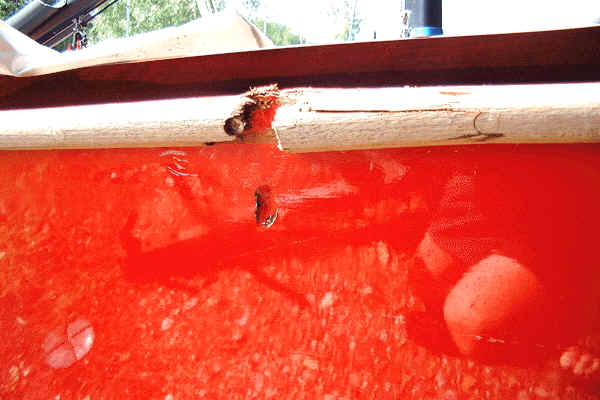
If there is damage (see
photo
of Anders Friis' W222 above), and insufficient
effort has been made to avoid the collision, even the
right-of-way boat is subject to being protested and
penalized - but only if the incident takes place while
the boats involved are racing.
In that case, the offender can do a Turns Penalty as
would be done for other infractions involving Part 2 of
the Rules - unless he has caused "serious damage" (see
rule 44.1)
... |
| 15
Acquiring
Right of Way When a boat acquires right of way, she shall initially give the other boat room to keep clear, unless she acquires right of way because of the other boat's actions. |
| Al's
note: As a protest committee member dealing with a
possible infraction of rule 15, I would "freeze the
action" at the moment a boat acquired right-of-way,
and then examine the relative positions of the two
boats. At that instant, the "give-way" boat has to be
in a position that will give her room to keep clear in
the existing conditions if she responds immediately.
If the new right-of-way boat is any closer than that
to the freshly burdened boat, she has broken rule 15. .. |
 |
|
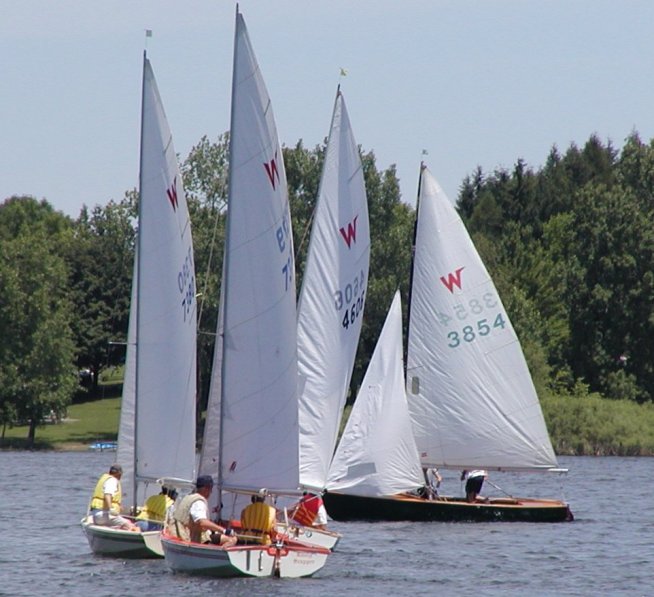
Probably the most common
way in which boats racing acquire right-of-way, is by
tacking to starboard near a port-tack boat - as Uncle Al
(3854) has just finished doing above. Al lost his
right-of-way position as a boat clear ahead while he
tacked, then re-acquired right of way when he completed
his tack onto starboard. Al now has to "initially give
the other boat (Dwight Aplevich in W4606) room to keep clear".
"initially" means "at the beginning". Thus, at the moment (captured above) Al completes his tack and becomes the right-of-way boat, the other boat (Dwight in W4606) must immediately begin to take any necessary evasive action. Spending a few seconds deciding whether to tack or bear away will not be acceptable. I have found it very useful to loudly and clearly hail "Tacking to starboard!!" in such a situation, so that the port boat has a second or two to decide whether she should tack or bear away, and at the very least is warned that I'm going to be coming at them. A silent tack too often results in the port boat not realizing that I have tacked until it's too late, at which point it's human nature for the port-tacker to feel that the other boat must have tacked too close. "room" is of course "the space required in the conditions to manoeuvre promptly in a seamanlike manner". As if the word "initially" were not enough, the requirement for immediate reaction is underscored by the word "promptly" in the definition of room. In a Wayfarer, there is no reason why the evasive manoeuvre should not begin immediately when you're in a situation such as the one above. Large yachts with running backstays and such, or a boat with a trapezing crew, would need to be given a longer time in which to react. "keep clear": If the
newly burdened boat reacts promptly and in a seamanlike
manner but still ends up in the way of, or colliding
with, the other boat, then the boat that has just
acquired right-of-way has not given the other
boat "room to keep clear" and should be penalized. Rule
15 does not offer the newly burdened boat the
privilege of choosing her preferred method of keeping
clear.
Al's note: I look at
this Rule as simply telling us that if we acquire
right-of-way near another boat, we must do so far
enough away in time and space that the newly burdened
boat will have a reasonable opportunity to keep clear
without having to resort desperate measures.
... |
 |
|
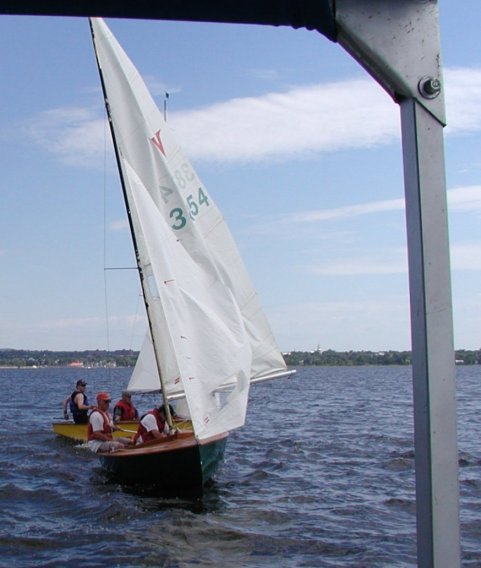
Probably the most common
right-of-way switch between boats on the same tack
occurs when a faster moving boat that was clear astern
(like the yellow-hulled Buttercup above),
establishes an overlap to leeward of a boat "sitting" on
the starting line with sails luffing - as is about to
happen in the photo on the left.
...The photo was taken a few seconds before the start. Uncle Al (3854) is sitting about a boat length aft of the RC boat with his sails totally eased and luffing and with virtually no forward momentum. Brian Egan, helming Buttercup, is close-reaching in at good speed and will establish a leeward overlap in the next second or so. But at this exact moment, Al is not yet required to take any evasive action. According to Case 53, he does not have to "anticipate his obligation to keep clear". This is quite a safe position for Al who has to "initially" be given "room to keep clear". As soon as the leeward overlap is established, Al must sheet his sails in and re-develop forward momentum and steerage way - all of which takes time - during which Brian must still give Al room to keep clear. While all this is happening, Brian must also go far enough to leeward to avoid snagging the end of Al's boom as it is rapidly pulled in (in a seamanlike manner, of course!!). By this time, the speed differential between the two boats should ensure that Brian is past Al before he can cause the latter any problems - unless he luffs up very sharply right after passing the end of Al's boom, a matter which will be discussed next under Rule 16.1. |
 |
|
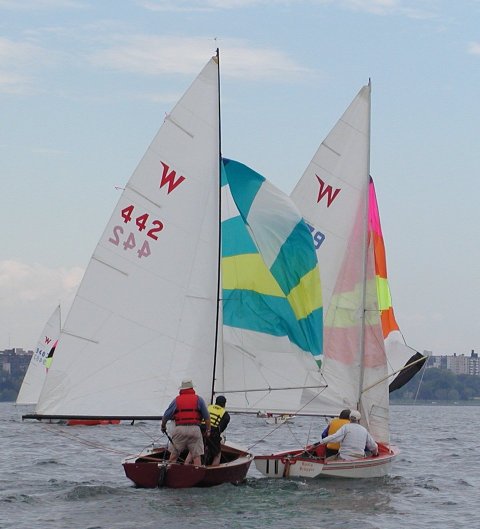
The other common
situation in which a leeward overlap is often
established from clear astern is on the run. Above -
bear in mind that zoom lens photos are deceiving! - Alan
Hallwood (W442) appears to be establishing a leeward
overlap from clear astern but seems to be leaving Fred
Black (W7379) very little room to keep clear. Alan, the
overtaking boat, must be careful about establishing his
leeward right-of-way position too close to Fred's hull.
Fred will have to turn to windward to keep clear - as he
is doing here, and that means his transom is pivoting to
leeward. If Alan comes in so close to Fred that Fred's
hull makes contact with Alan's boat as soon as Fred
tries to luff up to get out of the way, Alan has not
given him room to keep clear.
... |
 |
|
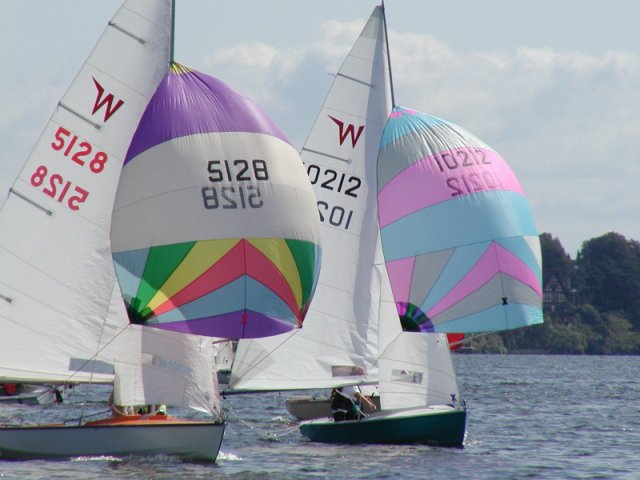
In the photo above,
Søren Jensen in W10212 may soon want to gybe to
starboard. When he does so, he will acquire right of way
over Christian Bovet in W5128, and must initially give
Christian room to keep clear. After a few seconds (long
enough to prepare for a spinnaker gybe for instance),
rule 15 will cease to apply (because of the word
"initially") and rules 10 (Opposite Tacks) and 16
(Changing Course) will apply as necessary.
... |
| 16 Changing Course 16.1 When a right-of-way boat changes course, she shall give the other boat room to keep clear. |
|
Al's note: In my
experience, Rule 16 is the most frequently broken
Rule in the book these days. Starting with myself,
we often find Rule 16 difficult to obey because, at
times, it goes against all our instincts that tell
us we should be entitled to do things we've always
done - like sail proper course when we have the
right-of-way position. More on this below!!
In the decision
for Case
26, it is pointed out that "the main purpose
of the rules of Part 2 is to avoid contact between
boats". Rule 16 is very much in line with that
philosophy.
..
|
 |
|
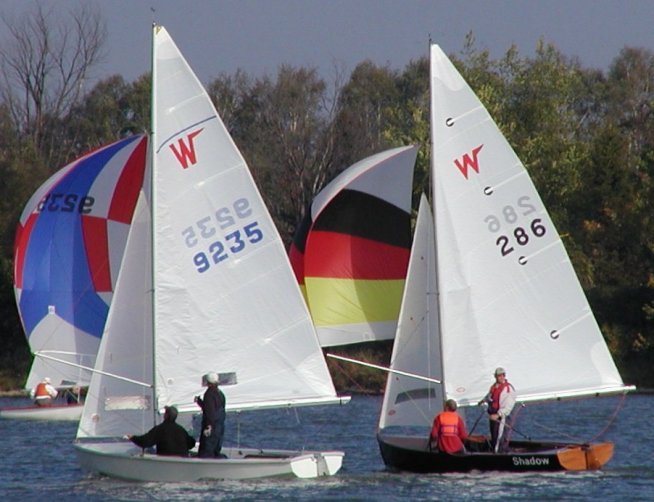
Assuming that Peter Rahn
(W286) has not established his overlap from clear
astern, he may alter course towards Brian Jeffs (W9235).
There is no longer a "luffing" rule, no more
"mast abeam" and other fun stuff. Such activities are
now controlled by rule 16.1. In essence, luffing matches
have become an exercise in futility (IMHO) because the
two boats quickly reach a stand-off in which they are
just far enough apart that Windward is still keeping
clear but that any further course alteration by Leeward
towards Windward will constitute a foul under rule 16.1.
If you are going to defend your wind these days, it is
much wiser to make a decisive move to windward before an
overtaking boat establishes a windward overlap - and
that, I am sure, is what the rules makers had in mind.
... |
 |
|
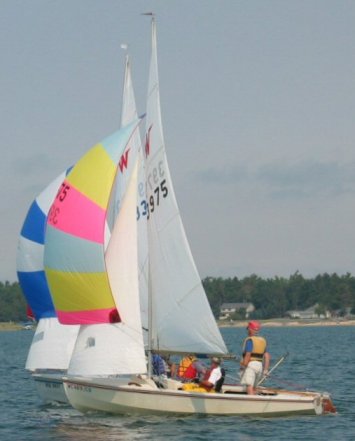
Above, we have a similar
situation: Assuming Bob Frick (W3975) has the right to
sail above his proper course, he can do that - but again
must stop changing his course towards Geoff Edwards to
windward of him when the latter is so close aboard that
he is on the verge of being no longer able to keep
clear. If the two boats are converging because Bob
changed course at a time when Geoff did have room to
respond, Bob is entitled to keep sailing that
converging course and it is up to Geoff to get out of
the way.
... |
 |
|
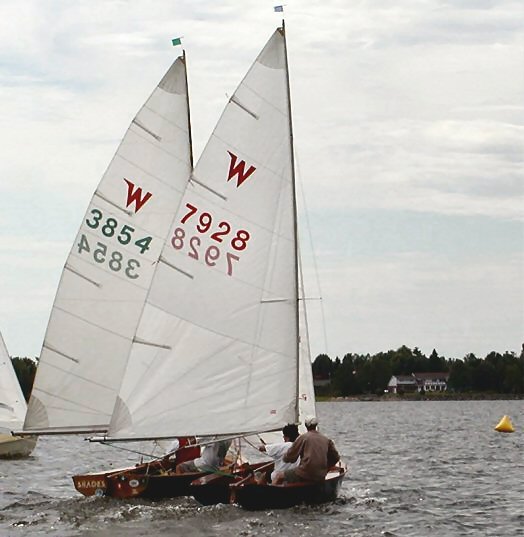
Rule 16.1 also applies
here: Just before the start signal, Doug Netherton
(7928) and Uncle Al (3854) seem to have come so close
together that Al, being leeward boat and thus having
right-of-way, must be careful not to infringe rule 16.1.
He appears to be pretty much in the position where he is
no longer permitted to change course towards Doug, not
even to assume his proper, close-hauled course and/or
to cross the starting line. Of course, such a
problem can be avoided by sitting on the line with your
bow pointed in at least a close-hauled direction!!
... |
 |
|
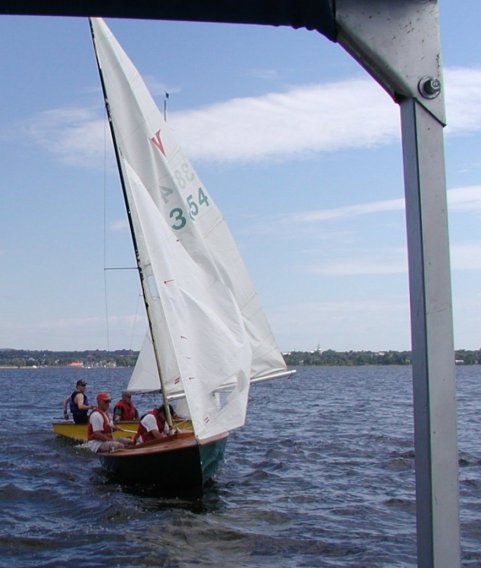
Once Brian Egan (yellow
hull) has acquired right-of-way and "initially given
Uncle Al (3854) room to keep clear", Brian is still
bound by 16.1 which limits him to changing course only
in such a way that Al will be left with room to keep
clear. Since Al will just be starting to regain steerage
way by the time Brian gets past Al's boom, Brian must
take care not to alter course too violently to windward
towards Al who will have limited ability to respond. If
Al does a prompt, seamanlike job of trying to keep
clear, but Brian still hits him because Brian has
changed course, Brian has broken rule 16.1.
... |
 |
|
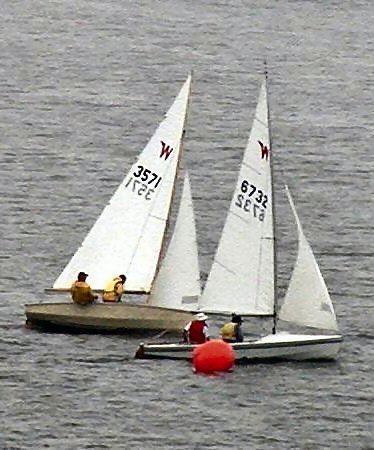
A common misconception
is that the "new" rules permit "barging" at the windward
end of a starting line. Above, Len Macdougall (W6732) is
so close to the start mark that he has nowhere to go and
will not be able to change course to keep clear. In this
situation, it is true that Bob Kennedy (W3571)
is not permitted - under 16.1 - to alter course towards
Len in such a way that the latter is unable to keep
clear, which would be the case here. Bob is
however entitled to hold his course and/or speed up. If
Bob limits himself to that, and the two boats converge
to a near collision which Bob then avoids by bearing
away, then Len has fouled Bob under rule 11 (Same Tack,
Overlapped). Rule 18
(Buoy Room) does not, of course, apply at a start mark
surrounded by navigable water.
... |
 |
|
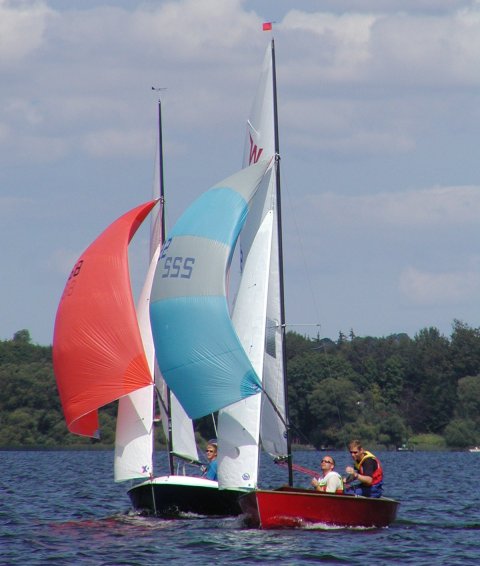
One more time!! Uncle Al
(red spi) is leeward and has right-of-way over Anders
Friis (W222) who must keep clear of Al. As long as the
latter holds his course, the keep clear responsibility
is all Anders', but if Uncle Al luffs up, he must take
care to do so in such a way as to give Anders room to
keep clear!!
... |
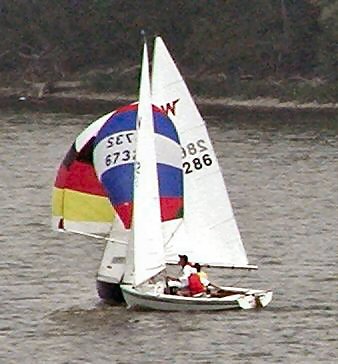 |
| Again - zoom lenses do, of course, lie! But if Peter (286) and Len (6732) are really this close together running on opposite tacks, Len (starboard) must avoid changing course towards Peter (port) at all costs. Len is however entitled to hold his converging course until Peter either alters course to keep clear or until Len decides he has to bear away or gybe to avoid an imminent collision. In the latter case, Peter will have fouled Len under rule 10. |
 |
|
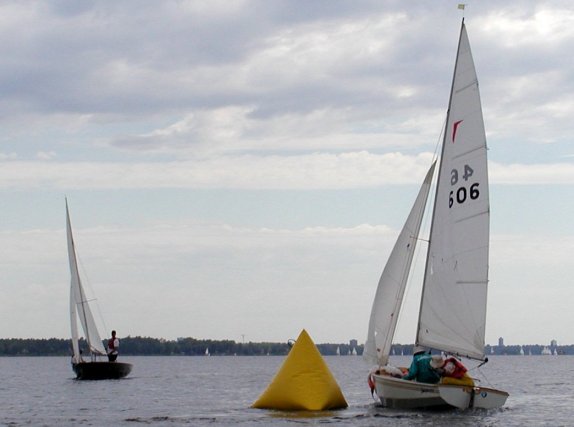
In this photo, Peter
(black hull on port tack) is too far away for rule 16 to
apply - but I had nothing better in my files. Imagine
Peter, if you will, about one boatlength off Dwight
Aplevich's bow (4606), and you will see a situation in
which rule 16.1 applies. Dwight is in the process of
turning from his close-hauled course onto a run and
sailing his proper course. But rule 16 takes precedence
over sailing proper course, and the turning right-of-way
boat must take care not to alter course in such a way as
to break rule 16.1 (or 16.2). This situation typically
occurs - as it does here - at the end of a buoys to port
beat which is followed by a run.
... |
 |
|
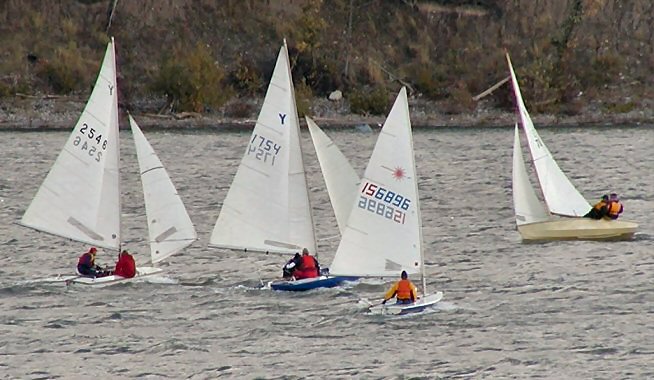
Here, the three
starboard tackers running down Fanshawe Lake near
London, Ontario, must take care not to change course in
such a way as to deprive Bob Kennedy who is close-hauled
on port tack, of room to keep clear. Y-Flyer 2546
especially must be careful not to bear away onto a
collision course with Bob, since such a course change by
2546 would leave Bob with virtually no way of safely
keeping clear - Bob certainly wouldn't want to have to
tack a few seconds from now!!
... |
 |
|
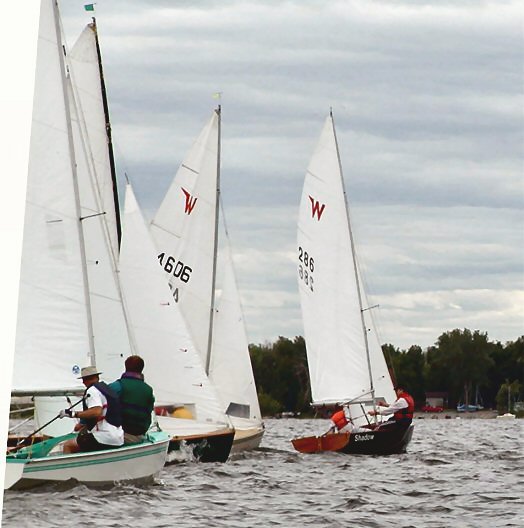
In this starting line
shot from the 2003 Wayfarer Ontarios off the Lac
Deschênes SC on the Ottawa River near Ottawa, the "gun"
has just gone and Jamie and Ben Abbott (green deck, not
the boatbuilding Abbotts!) have still not assumed a
totally close-hauled course. Meanwhile, Uncle Al (on
port tack, looking like he's about to be cut in half by
the Abbotts - that good old zoom lens again!!) has seen
the writing on the wall. Having gybed away from the
starting line after realizing he'd never lay the pin, Al
is now rolling through on port tack and close enough to
Jamie that the latter is not allowed - under 16.1 - to
luff up to his proper, close-hauled course if such a
course change will prevent Uncle Al from keeping clear.
(Al's note: We actually crossed the Abbotts with
nearly a boatlength to spare!! Shows you what the
camera can do!!)
... |
| 16 Changing Course 16.2 In addition, when after the starting a port-tack boat is keeping clear by sailing to |
 |
|
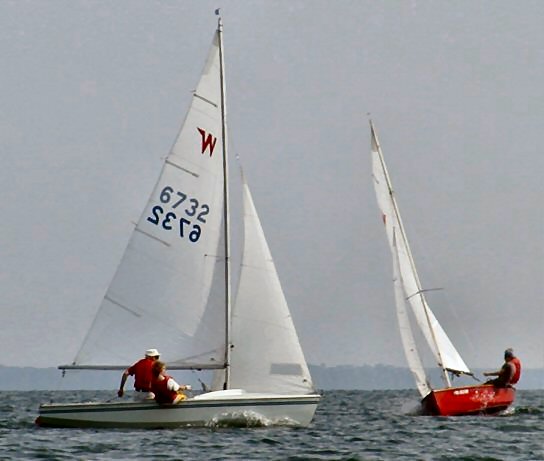
Our poor Chief Measurer,
Len Macdougall (W6732)! I had to use a mirror image of
the original photo to put him on starboard and cast him
in the role of potential villain!! All this to
illustrate that 16.2 prevents the starboard boat from
"hunting" a port tacker by bearing away. Here Joe
DeBrincat (red hull) is on port and keeping clear
nicely. 16.2 prevents Len from bearing away in such a
way as to make Joe immediately have to do more to keep
clear. Even a windshift will be no excuse for bending or
breaking rule 16.2.
... |
 |
|
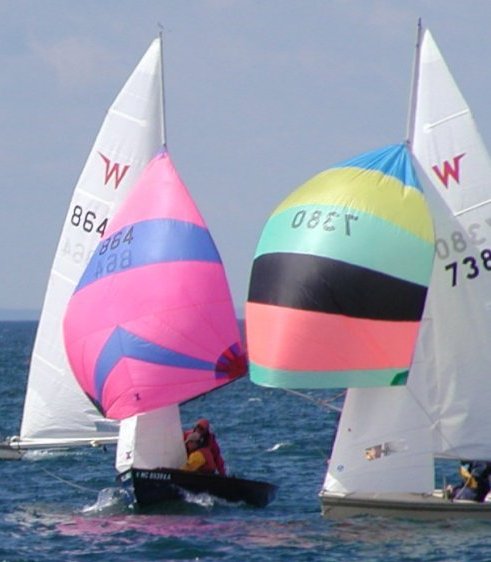
Rule 16.2 can, one
supposes, apply between boats on a run but the two boats
would have to be very close to each other. If Nick (864
above) chooses to luff up across Paul Laderoute's
transom (7380), Nick will be cutting it very fine and
Paul will not be allowed to make any course alteration "if as a result" Nick (the port-tack
boat) will "immediately need to change course to
continue keeping
clear."
.. |
| 17 On the Same
Tack; Proper Course If a boat clear astern becomes overlapped within two of her hull lengths to leeward of a boat on the same tack, she shall not sail above her proper course while they remain on the same tack and overlapped within that distance, unless in doing so she promptly sails astern of the other boat. This rule does not apply if the overlap begins while the windward boat is required by rule 13 to keep clear. |
 |
| Rule 17 never
applies before the start where there is no such thing as
proper course. However, pre-start manoeuverings do have a
bearing on Rule 17 as follows:. |
 |
|
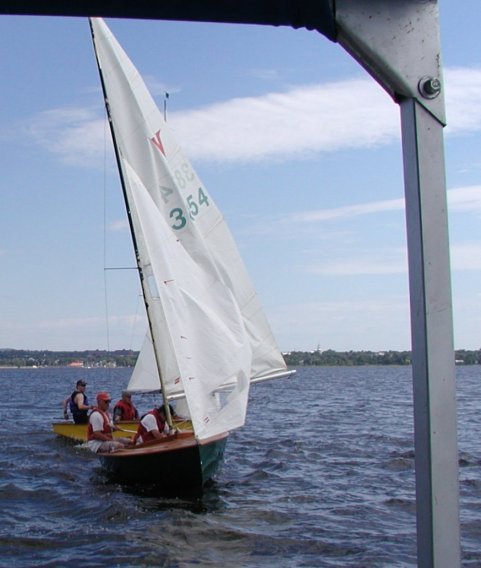
Useful picture, this
one! If a boat has become overlapped within two lengths
to leeward from clear astern as yellow hull is about to
do here, then she is bound by rule 17. Before the start
that does not matter (no proper course!) but once the
gun goes, she must sail no higher than proper course,
i.e. close-hauled in this case. So - if in a few
seconds, both Brian and Al (3854) end up sitting on the
line beside each other and nearly head to wind, Brian
must bear off to close-hauled as soon as the start
signal is made. If Brian's overlap was not established
from clear astern, he can sit head to wind forever if he
is so (suicidally) inclined!!
... |
 |
|
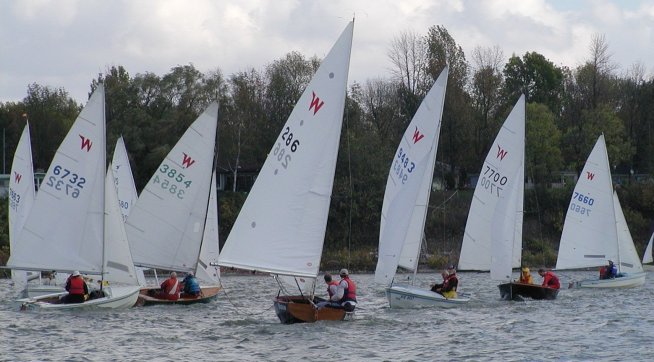
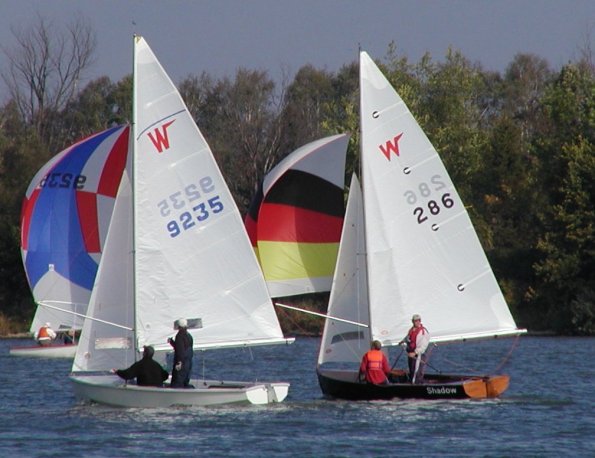
Here Peter Rahn (W286)
has established an overlap from clear astern within two
boatlengths of Brian Jeffs (W9235). While they remain
overlapped and within two lengths of each other, Peter
is not permitted to sail higher than his proper course.
This limitation on Peter's rights as leeward boat does
not however, confer any rights on the windward boat.
Many windward boats in this situation mistakenly believe
they are now entitled to sail their own proper
course and leeward must keep clear. Nothing could be
further from the truth ... well, perhaps a few
government pronouncements ... but you get the idea.
...Note also that the the end of the first sentence of 17 does permit Peter to sail above his proper course if in doing so, he promptly sails astern of the other boat. The photo above illustrates this possibility very nicely. Rule 17 permits Peter to luff up sharply and cross Brian's transom in an attempt to get to windward of Brian. Still with the photo above, Peter is entitled to sail his proper course which might well be to sail higher than he is doing now in order to protect his wind from boats other than 9235 coming up from astern to pass to windward. Or Peter - like Uncle Al - may have a history of sailing "up in the lulls but down with the puffs" on the run, and that, too, would be permissible as his proper course, provided he is careful to change his course only in such a way as to give Brian room to keep clear (rule 16). |
 |
|
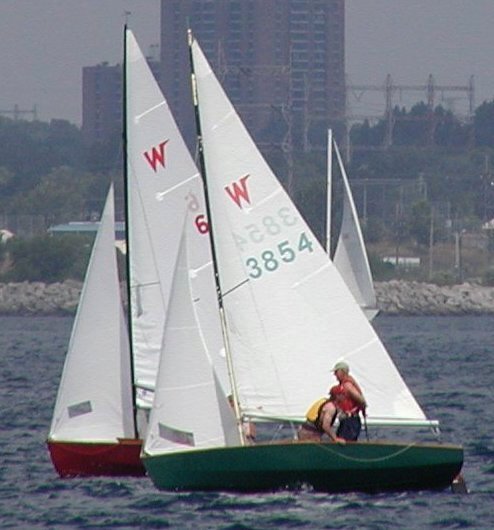
Another familiar
picture! But it does illustrate the point perfectly!!
Here Uncle Al (W3854) has just crossed Heider Funck (W6)
and tacked to cover. While Al was tacking, Heider became
overlapped within two lengths from clear astern, which
would cause 17 to "kick in", if it were not for the
second sentence of 17 which indicates: "This rule does not
apply if the overlap begins while the windward
boat is required by rule 13 to keep clear." So
here, Heider would be permitted to sail above his
proper course, because the overlap began while Al was
tacking.
... |
|
Rules
in
Pictures index
DefinitionsPart 2A Part 2B Part 2C Part 2D + penalty turns Photo-based Rules Quiz - 1 Photo-based Rules Quiz - 2 |