|
|
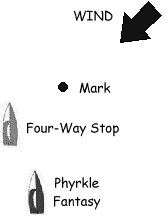
31. Facts Found: In 15 knots of breeze, Four-Way Stop was approaching
the windward mark of a buoys to starboard course on starboard tack with
Phyrkle Fantasy
half a length off the windward corner of his transom as shown in the
diagram on the left. Phyrkle
informed Four-Way that Four-Way would not have the
right to tack in this situation.
|
|
|
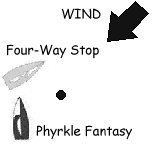
At the mark, Four-Way tacked. Phyrkle was forced to bear away
violently to avoid contact with 4-Way
while 4-Way Stop was
tacking. Phyrkle lodged a
valid protest.
|
.....
Ruling:
Even
though the boats were on a beat, rule 18
applied since they were not on opposite tacks. Since Four-Way
Stop
was clear ahead
when she reached the zone,
she was entitled to mark-room under rule 18.2(b). Rule 18.2(c) does however state: "if
the boat entitled to mark-room passes head to wind or
leaves the zone,
rule 18.2(b) ceases to apply"
At
this point, Four-Way
Stop
became subject to rule 13 which
she broke. The protest is upheld
and Four-Way
Stop
is disqualified.
.....
NOTE:
What
the boat clear
ahead should do in this situation if she is close enough to the
mark, is to luff
up but
not tack
alongside the mark. This forces a boat close astern to bear off and
pass to leeward (or pass on the wrong side of the mark!!!!). Once FWS becomes overlapped inside of PF, the mark-room definition says "mark-room does not include room to tack unless the boat is overlapped
to windward
and on the inside of the
boat required to give mark-room."
and it becomes safe and legal for the inside boat to complete the tack.
This
whole situation arises only if the boat clear astern is very close.
Therefore only a very brief luff will be required - you might think of
it as an extremely slow tack - remembering that the official tack does
not start until you've passed head to wind (rule 13)!
.....
Case #32
return to Quiz Index
|