|
SPINNAKER SHEETING PLUS HALYARD CLEATS FOR PACKED SPINNAKER 27 Jan 2011 addition! Picture of Uncle Al's spi halyard stowage system that keeps the not-in-use halyard tensioned and out of the crew's face. Rationale:
I recommend one long spinnaker sheet - 58' of
5 mil. soft-braid. Continuous
sheeting is neater and assures
that you never lose a sheet for any reason. The
lighter, thinner sheets
are a must since they keep the chute flying in
lighter airs and cleat
much
more securely in the clam cleats at the shrouds than
does the more
commonly
used ¼" line. (This is
important!)
Our sheets and halyard are attached to the spinnaker
with small
bowlines
(which are very easy to do with a bit of practice).
This saves weight
on
the sheets as well as potential mast top foul-ups
that result from
using
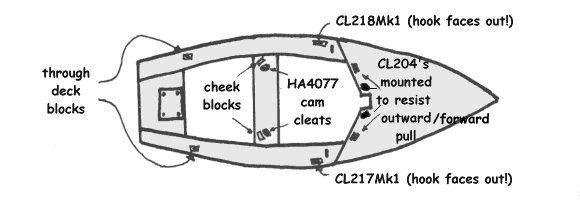
snaphooks on the halyard. The two black clam cleats
mounted to resist
outward
tension on the aft part of the foredeck (see
diagram) and the
two
silver clam cleats at the shrouds (CL 217&218
Mk. 1) are a big help
in two ways. Once the
spinny is
packed in
its bucket and the sheets and halyard are attached
you will note that
the
halyard hangs all over the jib sheet if the spi is
on the leeward side
and flops around the mast, into the mainsail or the
crew’s face if the
spinny is to windward. By taking some slack in the
halyard and passing
it in front of the shroud and then hooking it over
the hook at the
front
of the silver cleat and finally laying it into the
black clam cleat and
putting the whole thing under tension the spinny
halyard effectively
runs
up along the shroud and is out of the way until you
take it from cleat
and hook just before hoisting. Installation: The above diagram shows locations of necessary fittings. You should note the following, however:
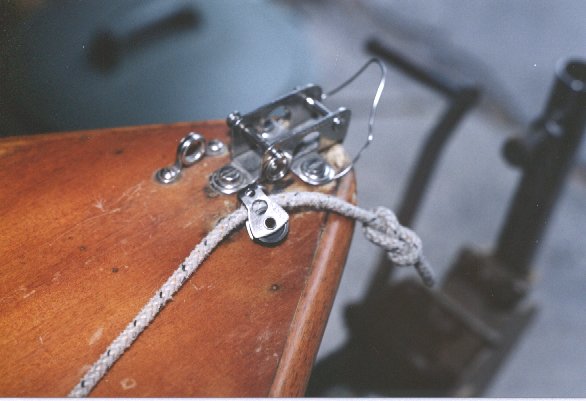
Addendum: The photo
below shows one other
useful
item - installation of a spinnaker sheet catcher
to help prevent the
sheet
from going under the boat. Ours is simply thin
stainless steel wire the
ends of which are wrapped around the two front
screws under our
forestay
plate. You'll note that it gets a lot of abuse:
|
Subject:
the
matter of the not-in-use spi hal stowage raises its
cute little head
On Wed, Jan 26, 2011 at 10:14 PM, Al Schonborn <uncle-al3854@cogeco.ca> wrote:
Sent:
Wednesday, January 26, 2011 10:19 PM
Weather looks excellent for great practice this weekend in charlotte, we will then head to eustis on tuesday. Richard J is chomping at the bit to try and make my foils prettier. Probably not the edges but just smoothing it out overall. Thanks for the picture. On Thu, Jan 27, 2011 at 11:27 AM, Al Schonborn <uncle-al3854@cogeco.ca> wrote: 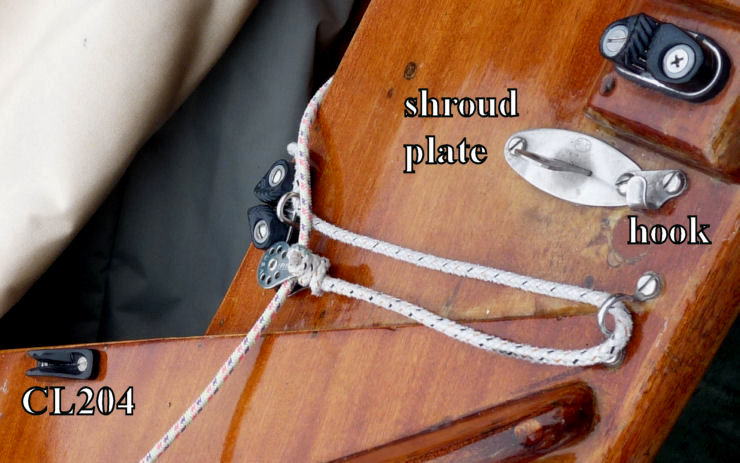 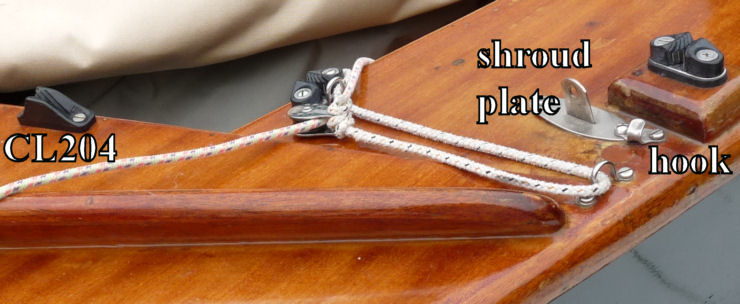 Hope you get decent weather. Have attached pics taken in my driveway a few minutes ago. Please note that this set-up was my first attempt and that the CL 204 is not properly lined up the way I mentioned last night (see also the email above) - something that I learned in many subsequent attempts when I still had my mini boat-rig business, Uncle Al's Corner. See you in
Eustis.
Best
regards,
Uncle
Al (W3854)
|