|
-----
Original Message -----
From:
Al Schonborn
To:
bcmurray
Sent:
Thursday,
September 06, 2001 12:25
AM
Subject:
starting rules question
Hi,
Brian:
Yours
is a very good question. As you tell this incident, you are absolutely
right: you did do exactly what was required of you. In this case, Rule
11 applies since you are approaching the start line to start which
means the Mark-Room Rule (#18)
does not apply (see Section
2C preamble)
In
Rule 11 the instruction is:
11
On the Same Tack, Overlapped
When boats are
on the same tack and overlapped, a windward boat shall keep clear of a leeward boat.
Your
question about whether a boat other than the one next to you can
protest you in this situation is like some
things in Math - they're obvious but hard to prove. As far as I am
aware, it is not specifically stated but has always been assumed, that
when you are in a mark-room situation or a windward/leeward situation,
your beef is with the boat immediately beside you (or immediately in
front of or behind you). As I understand it, the situation was
something like the diagram below:
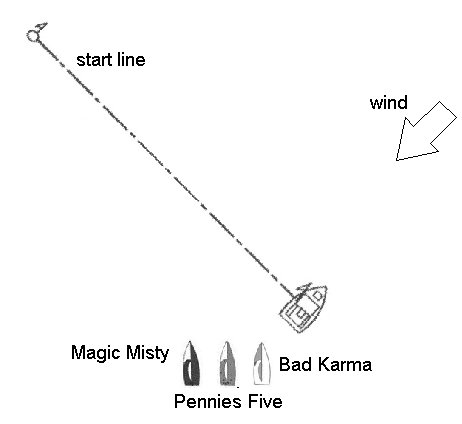
Three
boats overlapped, approaching the start line to start. If MM
has a problem, it is with PF not with BK. MM,
as the leeward and therefore right-of-way boat, is entitled to luff up
and PF must keep clear. If PF does not keep clear (be
it because he doesn't want to cut you off or whatever), he is the one
who is fouling MM and whom MM needs to protest. The
only one in the situation above that can protest you is PF - if you, as the windward boat, do
not keep clear. By the way, the right-of-way boat is also limited by
Rule 16.1:
16
Changing Course
16.1 When a right-of-way boat
changes course, she shall give the other boat room to keep clear.
This
means that MM can luff PF but not too rapidly, or PF
will not have room to keep clear.
Another
interesting point that comes up when my friends and I argue rules on
snowy winter evenings is the common perception that, under the "new"
rules, if a windward boat can stick its nose in between a leeward boat
and the RC boat or the mark, the leeward boat is not allowed to cut her
off, and that in this way, Windward can get away with barging.
This would probably be true in the situation above: Once BK has
reached a position where she can longer luff up without hitting the RC
boat, PF is prohibited by Rule 16.1, from altering course to
windward to force BK up further since PF will then not
be giving "the other boat room to keep clear".
However,
if I am the leeward boat and want to prevent a windward boat from
barging, the trick is to establish a straightline
course towards the corner of the RC boat that will cut the windward
boats off. In this way, I am not altering course as the boats get
closer and closer together, and am therefore not breaking Rule 16.1. I
may still have to give room because Rule 14 requires me to avoid a
collision:
14 Avoiding Contact
A boat shall avoid
contact
with another boat if reasonably possible. However, a right-of-way boat
or one entitled to room or mark-room
(a) need
not
act to avoid contact until it is clear that the other boat is not keeping clear or
giving room or mark-room, and
(b)
shall be
exonerated if she breaks this
rule and the contact does not cause damage or injury.
So,
if Windward starts sailing down into me because the alternative
for windward is to prong the RC boat, then I must avoid a collision by
bearing away and then protest windward. How close Windward can
come to you before you can justify the need to bear off and a foul by Windward
will depend on
a)
the wind and waves
b)
the size of the boats
c)
the judgment of the Protest Committee
Obviously,
Windward must get pretty darn close to Leeward
before the latter can claim a foul, or it would be too easy for Leeward
to cry foul when it's merely wishful thinking. A good committee will
make the right call.
Well,
Brian. This was fun. I hope it answers your question - or maybe it was
too much of an answer. ...
Anyway,
best wishes for happy sailing. Best regards,
Uncle
Al (W3854)
PS:
I presume that, since you mentioned nothing about Magic Misty
protesting you at the time of the incident, the protest was not heard
because MM failed to abide by Rule 61.1 which requires an immediate
display of a protest flag (for your boats which are not under 6 metres
long), and an immediate hail to the offending yacht:
61.1 Informing the Protestee
(a) A boat intending to protest shall inform the other boat at the
first reasonable opportunity. When her protest
will concern an incident in the racing area that she was involved in or
saw, she shall hail
‘Protest’ and conspicuously display a red flag at the first reasonable
opportunity for each. She shall display the flag until she is no longer
racing. However,
(1) if the other boat is beyond
hailing distance, the protesting boat need not hail but she shall
inform the other boat at the first reasonable opportunity;
(2) if the hull length of the protesting boat is less than 6 metres,
she need not display a red flag;
(3) if
the incident was an error by the other boat in sailing the course, she
need not hail or display a red flag but she shall inform the other boat
before that boat finishes
or at
the first reasonable opportunity after she finishes;
(4) if the incident results
in
damage or injury that
is obvious to the boats involved and one of them intends to protest,
the requirements of this rule do not apply to her, but she shall
attempt to inform the other boat within the time limit of rule 61.3.
Actually,
the
more I look at the rule above, the more I'm inclined to think that, in
theory, MM could protest you in the situation above, but only
if you actually fouled PF. Practically speaking, this would
require iron-clad proof that you had fouled PF - by colliding
with her for instance! If there was no collision and no protest from PF,
MM cannot hope to win such a protest. Again, MM's concern should be with PF
and not with you in this instance!
One
final
thought: If I were MM, I, too, would be upset but with PF
and not with you. I'm sure that PF wanted to be nice to you and
let you in, but PF was not allowed to do this by fouling
another boat.
|