Uncle Al
sings the praises of, and explains - with photos -
the virtues of, his Pamco trailer
(updated 22
November 2020)
From: Al Schonborn
To: The
Fullers
Sent: Friday,
October 05, 2001 9:26 PM
Subject: trailering
Hi,
Darcy:
Sorry
to be so long in getting back to you. I am not an
authority on trailers but will give you my opinion
in red below.
Uncle Al (W3854)
From: The
Fuller's
To: uncle-al@home.com
Sent: Sunday, September 23, 2001
6:52 PM
hey
Al
I
was just wondering what the best way to trailer and
launch Wayfarers are?
Would you use a dolly trailer combo
or just a trailer?
When I got W3854 in 1977, she came
with a UK-built combi-trailer (boat trailer with
slide-on dolly). While there are people who swear by
this set-up, it was my experience that their
suspension was not the best. Every bump in the road
went straight to the boat. Having been fortunate
enough to acquire a Michigan-built Pamco trailer
with W4000 in 1975, I had a basis for comparison -
and there was none!!! I kept the Pamco trailer which
goes over bumps that jar my teeth in my VW Golf
while the baby (W3854) barely vibrates. The bad news
is that I believe Pamco has gone out of business,
but I will describe the other things that make me
love this trailer which is still doing a super job
with heavy use over 25 years later - and I got it
used!
I
need to rebuild my trailer anyways, but I want to
build it so it will be most useful.
If at all
possible, you want a tilt-bed trailer with
longitudinal supports (mine fit just inside the
bilge keels on each side) set so that they keep
the boat reasonably level but do not support
significant weight (which should be supported by
the keel rollers). I believe Abbott's trailers
come with one or two V-shaped wooden but
carpeting-covered transverse supports (see
photo below)
...
 ...
...
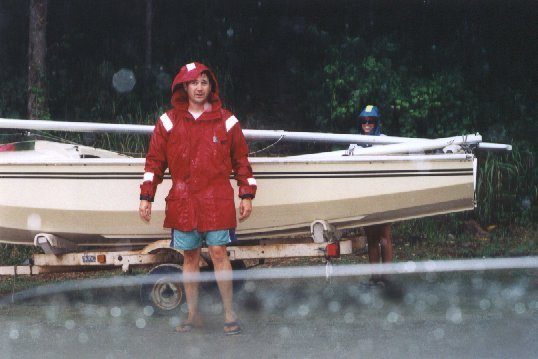
This more or less requires submerging the
trailer until the boat floats off - and in some
cases, where the water is quite shallow, that can
mean unhooking the trailer from the car and walking
in quite a ways. The alternative being to drag the
boat off and onto the trailer by main force (below).
I do not favour this approach.
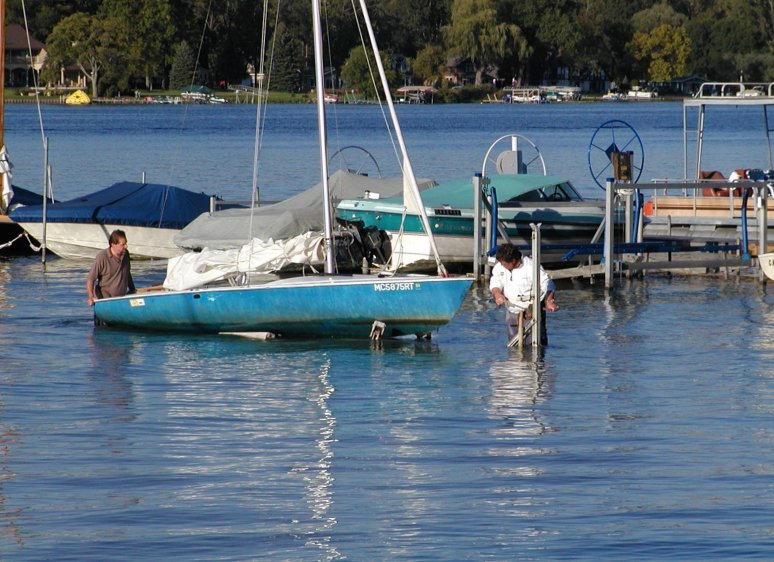 This is what happens when you don't
buy a tilt-bed trailer!
This is what happens when you don't
buy a tilt-bed trailer!
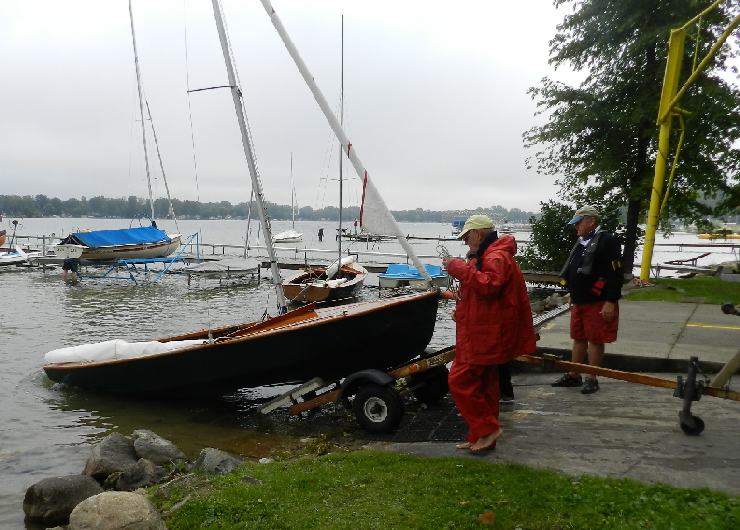
With the
tilt-bed (below) the tires - let alone the
bearings - barely kiss the water:
Other items
that I like (or would like):
We have a
nice, adjustable V-brace for the mast above the
winch assembly. When we get ready to trailer the
boat, we just take the mast down by removing only
the forestay from its fitting at the bow. Once the
mast is lying flat, we remove the mast pin and, even
with the shrouds attached, the mast just nicely
comes out from under the deck, after which we just
lay the foot of the mast into the V-support above
the winch assembly such that about three feet of
mast stick out past the transom.
It is good to
place the above assembly fore and aft such that the
tongue weight is not excessive - I would guess that
ours is about 50 lbs. and could/should be less. Once
that is set, you want to adjust the centre rollers
such that they each bear as equal a share of the
load as possible.
We have a tiny
wheel at the front of the trailer that was put on
when the boats went overseas by plane in 1983. A
much nicer set-up is a crank-up wheel assembly that
can be adjusted with a crank and folded out of the
way once the trailer is attached to the car. I'm
seriously contemplating getting one of these since
they allow you to store the boat totally level and
let any rain water drain out the open self-bailers
when the boat is on shore.
We're
hitting the circuit next year in Ontario.
We'll look forward to seeing you.
There will be an AGM + party in January which you
would be most welcome to attend if you want to meet
a few of the gang. The details will be posted in the
next month or so under Coming
Up on the Whiffle Web.
Hope
this helps you. Let me know if you want a picture of
our trailer which I could get in the next little
while if you think it would help.
Best
regards, Uncle Al.
Darcy Fuller W7566 (CAN66)
South Port
Sailing Club
-----
Original Message -----
From: The Fullers
To: Al Schonborn
Sent: Saturday, October 06, 2001
10:34 AM
If
you could get a picture that would help, too!
I was thinking on making a couple of cradles for the
hull to attach to the trailer so it's sitting
perfect, and maybe cut down the dolly and
attach it to the trailer in some way.
-----
Original Message -----
From: Al
Schonborn
To: The
Fullers
Sent:
Saturday, October 06, 2001 12:41 PM
I'll
go out and take a couple of pics right now - but I
don't know how soon the roll will be done. Within a
week, I hope.
The
trouble with having the boat too cradled will be
that you have to immerse the whole trailer to float
the little dear off. My experience is that it's best
just to have the keel support the whole weight of
the boat - and try to distribute that weight among
the rollers as well as possible. Many don't even
bother with this - and their boats seem not to
suffer that anyone can see.
Best
regards,
Uncle Al (W3854)
-----
Original Message -----
From: Al Schonborn
To: Al Schonborn
Sent: Friday, October 12, 2001 11:27
AM
Subject: trailer pics
Hi,
Darcy:
The
trailer pics are done. I'm just creating an
illustrated write-up which I will post later today -
along with our correspondence. Let me
know what remains unclear! Best regards,
Uncle Al
(W3854)
|
Uncle Al
talks Wayfarer trailers
I
suspect that no one in the Wayfarer world
has trailed his boat more often and more
miles than Uncle Al - not even George
Blanchard. Every year since I learned to
drive in 1966, my various Wayfarers have
gone to a dozen or more away regattas, and
I have trailed my Wayfarer thousands of
miles in each of the 35 sailing seasons
since then.
While
my early trailers were adequate, the real
breakthrough came in 1975 when I purchased
W4000 along with the Pamco trailer
in the photos below. To my mind the Pamco
trailer is without any doubt the finest
Wayfarer trailer ever made. And now for
the bad news: Pamco appears to have gone
out of business. I've searched the
Internet and been unable to find hide nor
hair of them.
What
I will do below however, is outline the
features that I find important in a
Wayfarer trailer and why I have found them
useful:
|
|
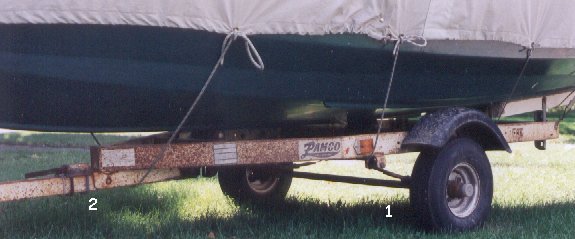
1. This trailer has an
excellent suspension. SHADES (above)
came with one of those snazzy UK-built
trailer/dolly combinations but what I
immediately noticed was that the boat got a
much bouncier ride than on the Pamco.
Of course, I had been getting spoiled
since I was used to going over bumps that
jarred my teeth in the car while my "baby" on
the Pamco trailer barely even
vibrated a bit!
2. The lever shown in the
photo can be pulled towards you allowing the
bed of the trailer to tilt. With this system I
regularly back the trailer up only until the
tires barely touch the water. This keeps the
bearings dry and I suppose prevents a certain
amount of grease from contaminating the water.
With longitudinal boat supports at the sides
(see #16 below), the trailer allows the boat
to gently slide off into the water as I gently
lift the bow to tilt the bed. Only in rocky
water less than 15 cm. deep, do I actually
have to be careful not to let the boat slide
off at will. In such instances, we keep the
winch rope (#10 below) as well as the painter
attached to the bow eye. One of us then gently
unwinches while the other attempts to lift the
transom a bit to prevent the tilt from
becoming too steep.
This is a distinct
improvement over some trailers that need to be
manhandled 100 feet into (and even worse,
out of!!!) shallow water before the
boat may finally float free! |
|
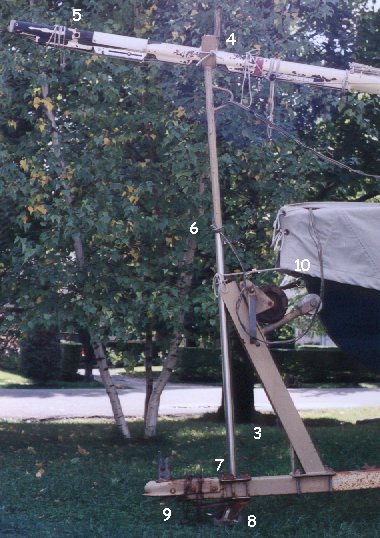
3. The front assembly of
the trailer is very important. I have seen a
number of Wayfarers struggle with a system
that is less well laid out than this.
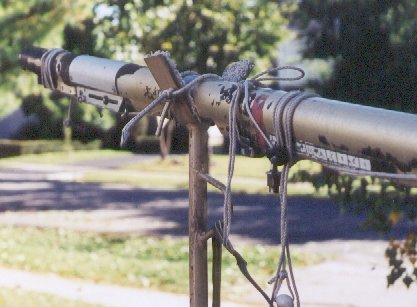
4. The V-shaped mast support
is now re-carpeted courtesy of Julia. See
photo below:
...
 ...
...
5. Note how our mast is
stored for trailer travel. I have seen any
number of Wayfarers do abundant unnecessary
work here. All we do after lowering the mast
is take the pivot pin out. The boat is so well
designed that without detaching the
shrouds from their chainplates on the deck,
the mast can be pulled aft just far enough to
get the foot past the aft edge of the
foredeck. Then it's a simple matter of sitting
on the front seat, lifting the mast over my
head (preferably with the crew lifting the aft
end - although George Blanchard has a little
wheel at the transom mast support so that he
can do the whole thing alone!) and passing it
forward until the spreaders pass my head. At
this point the mast is far enough forward and
I lower it into the V-bracket where it is
fastened with a simple shock cord loop that
goes over both sides of the V-bracket. All
that remains of this job is to tuck any shroud
bits hanging out of the boat inboard. This
works even if you trail without a cover on.
6. The V-strut is adjustable
as it is able to slide up and down inside the
lower vertical strut and kept in place by
tightening a bolt on the far side not shown in
these photos (sorry about that!).
7. One little drawback of
this arrangement was that the original lower
strut gathered water at its lower end and
eventually began to rust out. By the time I
drilled a little hole at the side as close to
the bottom plate as I could get, it was too
far gone. I went to the mast makers, Klacko's
here in Oakville and for a reasonable price,
they took the pieces of the old one and made
me the stainless replacement you can see
gleaming above. It was a very worthwhile
expense after the annoyance of having the old
one buckle while on the road far from home!
8. For SHADES' 1983
flight to the Worlds at Hayling, we had to
attach the little wheel you can just barely
see. This works OK on paved surfaces but if I
could figure out where to put it, 'd get the
bigger, adjustable fold-away model shown below
in an image from the Canadian Tire on-line
catalogue, part #0409035
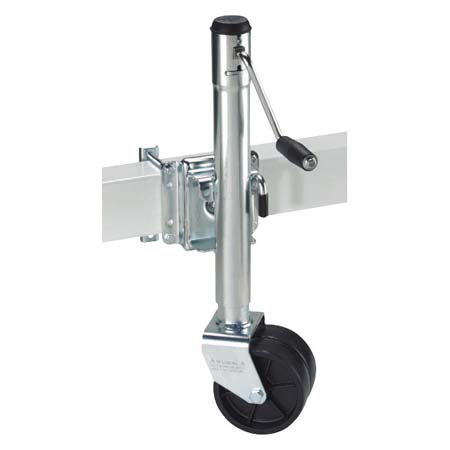 which would allow me to
winch it up to keep the boat exactly level in
the boat park so that any rainwater that gets
into the boat goes straight back out the
bailers!
which would allow me to
winch it up to keep the boat exactly level in
the boat park so that any rainwater that gets
into the boat goes straight back out the
bailers!
9. The safety chains that
come with the Pamco trailer simply end
in S-hooks which hang nicely from the pair of
eyes at the sides of my car's hitch - held in
places only by gravity. A very simple, fast
system - and neither chain has ever fallen off
by itself!
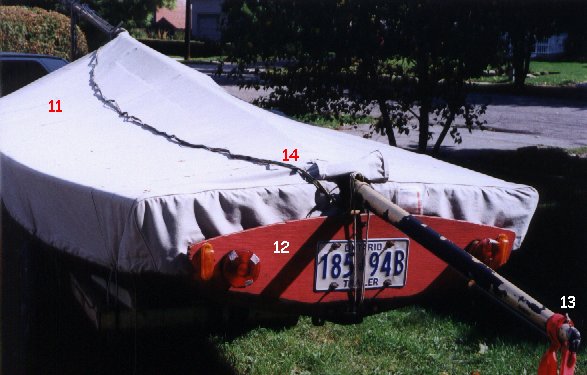
10. Ideally, the winch
should be at the same level as the bow eye
when the boat is on the trailer. Most trailers
are off on this and the boat has to be
manhandled the last foot or so until the bow
meets its receptacle. Even my bow eye is not
in perfect position (see photo) but it's
pretty darn close! |
|
11. The last Hans
Gottschling cover I trailed with (12-15
regattas/year as I have mentioned) lasted me
about 15 years. I had expected the cover to
flap itself to shreds but have been pleasantly
surprised to find that, while I am trailing,
the cover simply balloons into a nice airfoil
shape - presumably from air that enters the
slight aperture where the zipper meets the
mast and exits through the mast hole at the
back.
12. The trailer-lights board
- commonly used in Europe - is a wonderful
idea whose time is long overdue in North
America. This board was made for me by my
long-ago London, Ontario Fireball buddy, Dana
Seymour in 1972 when I was sailing a Fireball
(note the Fireball transom shape). On the
Fireball is hooked onto the boat's two rudder
fittings - we got an old bronze pintle and
gudgeon - cheap - that have done the job ever
since. You could make one that is more a
Wayfarer transom size and use two rudder
fittings to hold it in place - with
appropriate cover holes, of course. I, on the
other hand, was too lazy and have been hooking
on only the upper pintle while dead ending a
rope through the lower fitting (a gudgeon) and
tying it in position as shown above.
There are several beauties
to this system:
- the lights never get
immersed in water during launch
- wiring on a lights board
is much easier to repair than wiring inside
the angle iron of a trailer
- should the need arise, I
can tow someone else's trailer with my board
and not worry about his trailer lighting
system matching mine
- being at the end of the
boat not the trailer, the lights are close
enough to the mast tip to avoid any nitpicky
constable ticketing me for no extra light on
the mast tip - which under Ontario law is, I
believe, required where the mast tip is more
than 6 feet behind the lights (see #13 above)
- when the wiring goes, I
can just take the board and the car in to my
garage but leave the boat and trailer behind
- I can sit with the board
in my lap in the driver's seat to check that
all signals are go (see #14) |
|
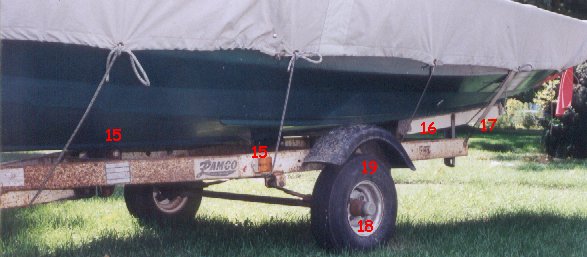
15. In this photo you can
see two of the three centre rollers that are
supposed to bear the lion's share of the boats
weight on the trailer. All three are
adjustable up and down and have been re-set so
that all three are right up against the keel
when SHADES has been fully winched up
onto her trailer.
16. Even though the
longitudinal outer supports cross under the
aft bulkhead, conventional wisdom is that they
should not support the boat's weight - a task
which is best left to the keel (see #15). On
this trailer, these supports have been
deliberately set a tiny bit low to keep boat
weight on the keel. Their only real job is to
keep the boat from tipping to one side or the
other. These too are carpet-covered of course!
17. By the same token, the
trailer strap does not need or want to be
excessively tight. Its only task is to keep
the boat from falling sideways off the trailer
not to press the boat onto the rollers more
than its weight already does!!
I still recall bringing W852
(my second Wayfarer) home from Ottawa after
buying her there. We had driven about 100
miles towards Toronto when, after a perhaps
slightly speedy left turn off Hwy 7, I
suddenly thought: Did I remember to tie the
boat down? We stopped - and sure enough - no
tie down. What this shows is that a Wayfarer
will not easily fall of a trailer (although I
managed to make it happen once - in 1966) and
certainly does not want to be really strapped
down to the trailer!
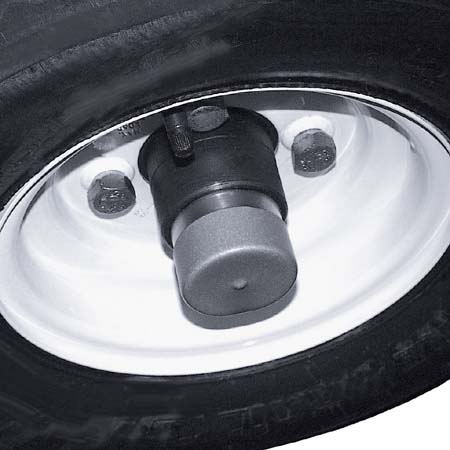
18. Another add-on to the
original trailer is what Canadian
Tire calls Wheel Bearing Protectors -
part #0408420P as borrowed from their site
below:
..
..
To let
them tell it, this product does the
following:
- Protects bearings from
dust and dirt
- Water Resistant
- Pressure ring keeps
grease in the bearing
- Eliminates the need to
repack the bearings
- Grease nipple allows
application of grease without removing
the bearing
- Heavy duty triple plated
metal resists corrosion
- Comes with vinyl cap for
added protection (Al's note: watch you
don't lose these since I did lose one
and had to use a bright green lid from
a can of shaving cream instead until
they finally took pity on me earlier
this year and replaced it when I was
in for service!)
19. I
never said I was a technical expert on
trailers, just experienced at putting them
to use. I went out this morning and checked
the tire walls where it says all kinds of
neat stuff. I think the reference to tire
size says: 5.70 x 8. Is that the
size? I couldn't figure out the sizes from
their catalogue either. Can someone clue me
in here??
What I
do know is that a few years ago, I decided
to go up from the smallest diameter trailer
tires that seem to be standard on most
trailers the right size to carry Wayfarers.
I gather this reduces heating from friction
since the larger wheels don't need to do a
many revolutions to go the same distance as
the smaller ones. This is particularly
useful if you do a lot of expressway
trailing - or heaven forbid - want to get
there faster than 100km/h. |
|
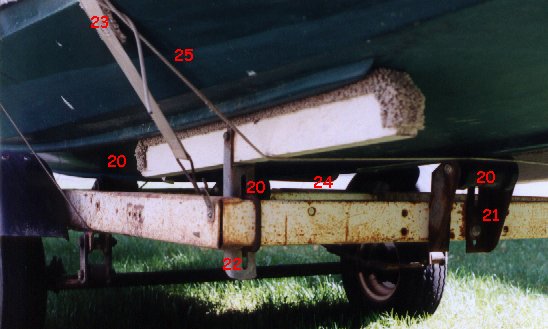
20. Note the centre
rollers (previous referred to in #15) adjusted
just right to fit the contours of the keel.
21. You can see here how
they can be adjusted.
22. Likewise for the
longitudinal outside supports which fit ever
so perfectly inside the bilge keel on each
side!
23. Note the carpet sewed
onto the trailer strap by my wife and
sometimes crew, Julia, to protect the paint on
the chine.
24. Oops! If your
board is prone to falling down when left
unsupported (like mine in this photo!), you
should make sure you keep that from happening.
Since I like the tightness of my centreboard
brake which is just right to stay in position
while racing but not too hard for my various
crews to move, I don't want to use this method
- even if could get at it with the board full
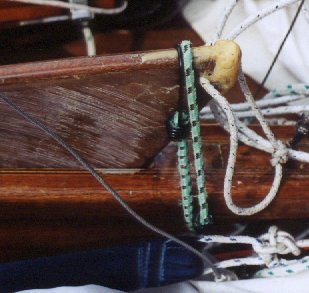
up! What I use instead is one of those 1/4"
bungy cords with metal hooks on the ends. The
latter hook nicely under the forward part of
the CB box after being wrapped once or twice
around the box and the top corner of the
centreboard as shown below:
...
 ...
...
If you don't keep the board
fully up in this or some other way, what
happens is that when you slide the boat off
the trailer, the board angles further down -
having been supported previous by the middle
roller - and gets caught on the aft roller. If
you launch with a certain amount of panache
and flourish, the latter comes to a sickening
end when the wafer thin trailing edge of the
board you spent many winter hours on comes to
a sickening, crunching, grinding halt against
the aft roller and or the launch ramp!
I've done this a couple of
times and would dearly love never to do it
again - but you can see above, I could be
swearing at the Midwinters if I don't bungy
the board up before then.
In addition, it probably
does not help your leading edge to have to
support all the board weight in that one spot
but I've never noted any damage in that
regard.
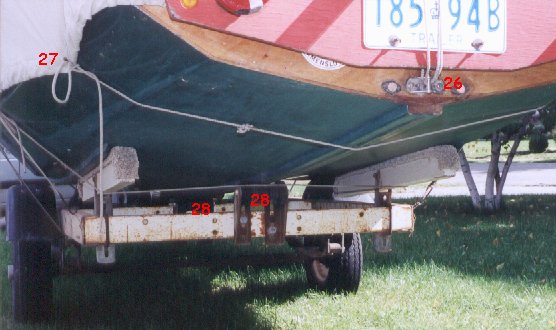
25. Note how we tie the
cover onto the boat by going right under
everything - trailer and all. See also #27) |
|
26. A close-up of how we
tie the trailer lights board into its position
after hooking its pintle at the upper end into
the gudgeon that is the upper boat fitting.
27. I just use a slip knot
to tie the cover on - over the years I've
developed a knack for snapping that half hitch
with the loop hard enough that it stays on all
the way from Oakville to Florida! And it's so
nice and easy to undo. Actually, I do a double
half hitch on the very front rope which for
some reason comes loose on long trips
otherwise!
28. One last look at those
well adjusted centre rollers!
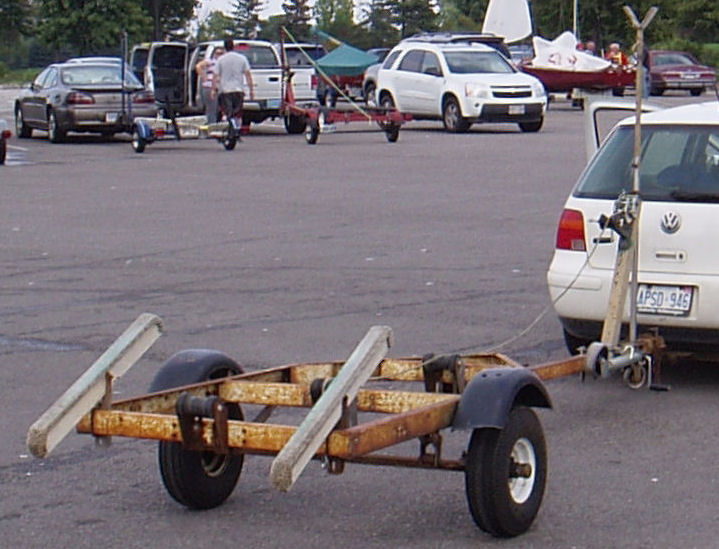 Our 2008 North Americans
"support team" got two pictures of our
beloved - if un-looked-after - Pamco
trailer.
Our 2008 North Americans
"support team" got two pictures of our
beloved - if un-looked-after - Pamco
trailer.
Note the recently added "Swiveljack" near
the front - a much appreciated Christmas
present from Julia.
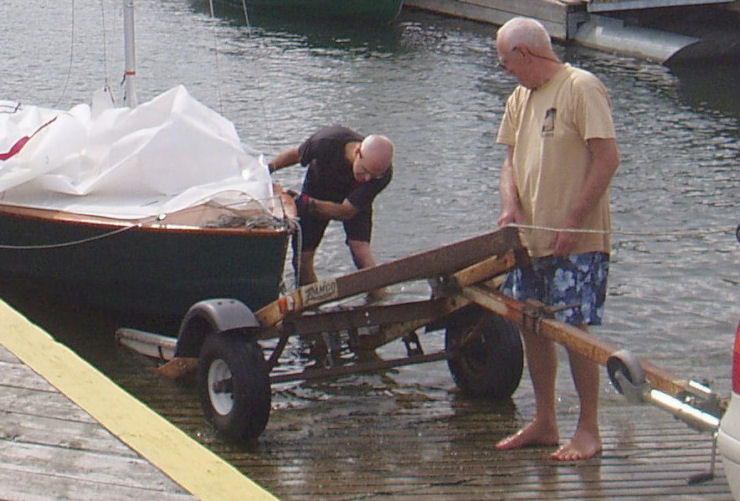
As closer view of the
swiveljack as Al (r) and Dave Hansman
carefully line up SHADES
before the winching starts. We do have to
be very precise when we line her up on the
rollers. The ones we have leave little
room for error and she'll easily slide off
them if not perfectly and continuously
aligned. One of us winches and and calls
to the "shroud holding" other: "Towards
(away from?) you a titch!", etc. to keep
our keelson perfectly aligned with all
three rollers. It's pretty easy if you
don't rush too much. Note, too, how the
tires are barely touching the water and
our axle and bearings never get immersed -
even on a far less ideal launch site than
this one.
|
|